
Recruitment Process Automation: How to Address Hiring Bias & Build Fairness

When it comes to recruitment process automation, many businesses aren’t sure what—or how much—they should automate. Concerns around regulations and candidate wariness only add to the dilemma for business leaders and HR heads. Yet roles need to be filled fast—before top talent walks away, hiring costs escalate, or work stalls for too long! But handling every task manually, especially with high application volumes, is painfully slow. And let’s face it: in today’s world of speed and precision, hiring shouldn’t take weeks or months. It’s no surprise, then, that more organizations now view automation as a key part of their hiring strategy. In this guide, you’ll discover which recruitment tasks are ideal for automation, how to safeguard against bias, and how to design a hiring process that’s not just efficient—but also fair and future-ready. Where Bias, Fairness, and Recruitment Process Automation Meet A bias-free recruitment system is critical to ensuring organizations don’t miss out on talent, suffer from a lack of diversity, or face legal risks. Strikingly, hiring bias and fair hiring are like opposite ends of the recruitment pipeline—one creates blockages, the other clears the way. An old proverb goes: There’s more than meets the eye! However, hiring systems—whether human-led or machine-driven (e.g., candidate assessment tools and applicant tracking systems (ATS))—might subscribe only to what’s obvious. Interestingly, stereotypes and clouded human perception and judgment can reflect in automated hiring systems through biased algorithms too. Even when an organization avoids intentional bias, unintentional bias can still creep into hiring decisions. It’s a loss when an organization unknowingly misses out on exceptional candidates—just because they don’t tick every conventional box, even if they might be a better fit for the role. So, it is critical to automate your hiring processes thoughtfully using the right tools and system design practices. Because a well-made recruitment automation system helps: A Strong Case for Automated Hiring Despite Skepticism Benefits, bias risk, and loss of control are the top considerations and concerns one may be looking at. Let’s go over these one by one and see what makes a strong case for automating hiring — despite skepticism or reservations. 1. Key Advantages? The inarguable benefits of recruitment automation! 2. Bias Risk? Ensure fairness via design and regular monitoring! 3. Loss of Control? Keep humans in the loop! 3 Layers of Mitigating Hiring Bias in HR Automation Unbiased recruitment is an amalgamation of a company’s HR ecosystem, culture, and practices. They are also the guiding ethics that define the vision and structure for recruitment automation. Understanding needs, goals, and scope is another critical step in deciding on architecture, tools, and workflows. Here are some good practices to follow if you are considering hiring automation. 1. Responsible Recruitment Automation Is Key Given the needs and benefits discussed so far, it’s clear that recruitment processes have much to gain from automation—when models are trained responsibly and regularly audited. Furthermore, you can create transparency in how metrics are collected or interpreted. Additionally, offering candidates the option to opt out or request a human review helps foster goodwill and reinforces fairness. 2. Compliance with AI Regulations in Recruitment Organizations and automation experts need to stay mindful of the evolving legal landscape and local AI regulations to ensure compliance when automating recruitment. Here is a quick look at AI-driven hiring regulations around the world: 3. Mapping Automation Models to Hiring Tasks Recruitment automation is transforming how companies hire. However, not all automation is created equal. When fairness and bias are top concerns, it’s critical to understand which processes can be safely automated. Fortunately, many recruitment tasks can be automated without compromising equity, transparency, or compliance. Others, however, may require deeper consideration—and more innovative frameworks for risk mitigation. 3 Tiers of Recruitment Process Automation: Safe, Safeguarded, Sophisticated Here’s a breakdown of key recruitment tasks, categorized by bias risk level and automation readiness! 1. Ideal and Safe for Bais-free Automation Following tasks are largely operational and do not involve subjective decision-making, making them ideal for automation: 2. Automate with Confidence with Safeguards These hiring tasks can benefit from automation if models are trained on diverse, representative data and supported by ongoing audits. 3. Build Bias-Aware Automation Design Some recruitment task automations require extra thought and checkpoints. Pairing bias-aware design with human oversight is the best way to approach them. For ex: Custom Recruitment Automation for Fair Hiring Do you know the number one cause of bias creeping into HR automation systems? Bias often enters through training data. Historical hiring patterns can encode discrimination (e.g., race, gender), for instance. Your recruitment tech stack might include everything from sourcing to applicant tracking system, and from scheduling to assessment and analytics tools. Imagine how bad data can lead to bad hiring decisions. The quality of your recruitment model’s training data matters! Significantly, custom recruitment automation solutions—such as Centelli’s Digital Workers—could be your safer option, as they’re custom-designed to match exact process needs. Fusing AI, ML, and NLP capabilities, Digital Worker bots are especially apt for operational and objective task automation. Why? Furthermore, the Digital Worker automation bots continue to evolve by leveraging process mining, LLMs, Gen AI, and other innovative technologies. (Download our Free HR Automation Guide!) Here are some tips to build an effective custom automated recruitment system: Looking for answers or want to explore Centelli’s custom HR and recruitment automation solutions? Drop us a line—we’d love to hear from you! Key Takeaways Many tasks are completely safe to automate, while some may require more advanced, innovative automation models. However, there are still some areas where AI maturity and automation is a work in progress. All in all: You May Also Like: Onboarding, Contract Management, and Policy Compliance
How Digital Workers Deliver Smarter, Scalable Data Management Automation

Picture your data processes — always on and free from manual effort. Data pipelines flow fast and seamlessly. Accuracy? Impeccable. Real-time insights? Delivered instantly. That’s the power of data management automation delivered by Digital Workers. So, you say goodbye to inefficiencies and add precision where it matters most! Old-school automation no longer cuts it, breaking down with the slightest application interface change, data variation, or workflow exception. Hence, savvy organizations are moving beyond classic tools in favour of solutions that ensure 24/7 accessible, reliable, and actionable data. Inside Data Management Automation with Digital Workers AI-powered software agents — aka Digital Workers — handle high-volume, rules-heavy, and time-sensitive tasks. They can manage the entire data lifecycle, from collection to reporting, without human intervention! 4 cornerstones of Digital Worker-led data management: Importantly, human oversight doesn’t have to be out of the picture unless you choose so. Significantly, with pre-defined rules and conditions, you can train these advanced bots to ask for validation, raise a query, or flag off unusual patterns and anomalies. So, you need not worry about bias or loss of control when digital workers drive your data management automation system. Now, let’s break down what Digital Workers can actually do behind the scenes! Automating Data Ingestion: No More Manual Effort The first step in any data process is getting the data in — and it’s often the most error-prone. Digital workers change that. It may span: Processing, Cleaning, and Validating Data Automatically Notably, data quality makes or breaks business decisions. Here’s how digital workers keep it clean, reliable, and consistent: Source: Tech Business News Seamless Data Movement, Integration, and Synchronization Also, moving data across systems is a common operational pain. Digital workers fix that. How? Organized, Scalable Data Storage and Management A well-managed data foundation ensures business growth without technical friction. Digital Workers realize it through: Turning Data into Insight, Faster Managing data is one thing — but turning it into actionable insights instantly? That’s exactly what digital workers deliver. Key examples include: Built-In Data Governance, Security, and Compliance With rising compliance demands and cyber threats, governance must be built into your data ops. However, digital workers handle it effortlessly. Things they can do: Your data challenges are unique — your automation should be too. Custom digital workers are designed around your business’s exact data management needs, workflows, and exceptions. Create Synthetic Data for Custom AI Modeling As AI adoption accelerates, businesses need secure, scalable, and diverse data for model development. Digital Workers automate synthetic data generation — producing artificial yet realistic data sets without exposing sensitive information. Key advantages: Join Our FREE AI & Automation Webinars!No jargon, no heavy tech. Discover expert insights, real-world cases, and POCs on how Intelligent Automation elevates business processes and drives value. Save your seat for the next session! Why Digital Workers Belong at the Heart of Modern Data Operations For modern businesses, the goal isn’t just efficiency — it’s building smarter, faster, and safer data operations that keep pace with constant change. However, legacy tools struggle in today’s fast-moving, interconnected environments. Here’s where digital worker-driven automation makes a difference. It empowers organizations to manage growing data demands reliably and at scale. The result? Maximized data assets, sharper business intelligence, and consistently better outcomes.
Email Triage with Digital Workers: Beyond Basic Automation
No, email triage isn’t just for overloaded office and business inboxes. Even lighter email flows can be disruptive. Time crunches, fragmented focus, and packed schedules are often to blame. In today’s near-instant digital communication world, how quickly and proactively you respond directly impacts revenue opportunities, customer experience, trust, and reputation. This is true no matter the size and scale of your business. But here’s the thing: Not all incoming emails carry the same value or importance. And amid the inpour, there’s always a risk of missing something you shouldn’t. For example: No business wants to risk communication gaps, mistakes, or missed opportunities. This is where Digital Workers make a difference. These intelligent automation software bots effortlessly declutter your inbox and smartly prioritize the messages that matter. Why Manual Triage and Basic Automation Aren’t Enough Another email drops in, and a decision needs to be made! Sources: OptinMonster, CloudHQ, OnFocus News How Manual Email Handling Typically Goes You have staff spending endless hours sifting through every single message to decide what to do next. It’s a time and resource-heavy chore. And it’s not just inefficient — it’s risky too. Don’t you think those hours could be better spent on tasks like coordinating operations, supporting other teams, or directly engaging with clients and customers — instead of just being glued to a screen? Then there’s the judgment factor. They might miss a critical message or mishandle one. And repetitive work like this is prone to human error as boredom and fatigue creep in. Here, automation offers a way out! You can leverage tools and rules to carry out pre-defined actions like sorting, filtering, and more. Things you can do include (But do remember — these are the simple things. Keep reading to uncover more advanced capabilities!): Did you notice the underpinning here? Low-level automation is confined by static if-then condition logic. Let’s dig deeper into this. Basic Email Triage Automation Can Go Only So Far Let’s be real. Foundational “if-then” automations might declutter your inbox a bit, but they’re far from a smart solution. Here’re the top four reasons why: In short, these setups might suit a small, low-volume inbox with predictable, routine messages. Email Automation Digital Worker’s Edge For dynamic, complex, and high-volume communication environments, basic automations fall short. That’s where you need a smarter tool like a Digital Worker – your AI-powered email assistant that delivers what a low-level automation won’t. Notably, Digital Worker can mimic human like actions and understanding to decipher the email context and take appropriate action in a seasoned admin-like fashion. Key capabilities these advanced software bots drive upon: Looking for custom Digital Worker-led email automation? Talk to our team! We build tailored solutions for every industry and business function, seamlessly integrating them across departments. Book a free call today. Why a Custom Digital Worker Wins at Email Triage Automation Off-the-shelf email triage tools can only take you so far. A custom-built AI Digital Worker is precisely tailored to your business communication, learning from your unique email data, messaging style, and workflows to automate triage with unparalleled precision and adaptability. Here’s what makes it a smarter choice: Check out CommsIQ, our customizable Email Triage Solution for the hospitality & travel industry. Bottom Line Your inbox can either drain your time or become a business advantage. And it’s not just about efficiency. You as well uplift customer satisfaction, strengthen partner trust, and improve employee experience in the process — all critical to business growth. Drop in a line for more info.
Gen AI and Automation: 7 Processes to Automate Before Gen AI Comes In
Gen AI and automation are top priorities for every business leader today. They’re under constant pressure to keep up with the latest technological trends! There is no doubt generative AI or Gen AI is transforming enterprise workflows. But the transition and adoption are not devoid of challenges! So, before bringing in tools like ChatGPT, Gemini, or Copilot, it’s wiser to automate first. It’s not a question of AI vs Automation — it’s about choosing a more pragmatic pathway to AI success. In this blog, we’ll tell you: Gen AI and Automation: Different Yet Complementary Traditional automation and generative AI are distinct concepts, not competing against each other. In fact, they’re synergistic. But before going ahead, let’s brush up on the concepts: Both technologies help you drive better efficiency and resource optimization. Human judgment and supervision add more reliability, nonetheless. Here’s the catch, though! CIOs are gung-ho about Gen AI, but there’s also dissatisfaction with current Gen AI results, Gartner notes. Well, Gen AI maturity, performance, and reliability are still a work in progress. But as said earlier, businesses can’t afford to miss riding the wave either. Hence, it makes even more sense to start by automating tasks you want Gen AI-enabled. Layer Up to Maximize Value: Automate First, AI Next Let’s understand how automation clears the decks, ensures best practices, and creates a solid AI foundation: Next, find out where the scope is! 7 Processes to Automate Before You Bring ChatGPT or Gemini So, you see it’s a win-win: automate simple stuff first and scale up to AI/Gen AI when you’re ready. Here’re the top workflows you should consider automating for Generative AI to truly shine. 1. Customer Service & Support 2. Data Analysis & Reporting 3. Finance & Accounting Download your free copy of our “AI and Automation in Finance Team” Guide here. 4. Human Resource Management Leading businesses across industries trust us to unlock the true power of Gen AI with smart, customized automation solutions. Let’s explore what’s possible for you — book a free online meeting today. Serving clients worldwide. 5. Legal, Compliance, Contract Documentation You May Also Like: Onboarding, Contract Management, and Policy Compliance – Centelli 6. Marketing, Sales, and CRM 7. Supply Chain & Logistics Don’t Fall for Gen AI vs Automation; Leverage the Power Duo Automating repetitive, high-volume, rule-based processes helps businesses eliminate inefficiencies, overcome compliance hurdles, and create a reliable launchpad for Gen AI success. This approach also reduces the time to implement more complex intelligent automations in the future. And do not forget the cost factor. Freemiums might suffice for individuals and small firms, but enterprise-grade paid generative AI tools are the way to go if you’re a medium or large-sized company. Layering AI on automation ensures the AI model can be trained as per your exact operational needs. Importantly, it serves as your AI investment safety net, streamlining costs overall. Drop us a line if you need more info or have any questions.
AI Made Realistic – Managing Hype, Risks and Practicality
The promise of AI is everywhere – efficiency, insight, automation – but so too are the risks it brings! Managing AI hype and risks is the first step toward turning its big promises into realistic, practical outcomes. Why is this so important? The message is therefore clear: AI is powerful – but also risky. Without careful controls, AI can make unintended decisions, leak data, or fall prey to manipulation. Managing this requires a strategic, proactive approach—one that balances ambition with responsibility. Navigating AI Hype and Risks: Recommendations to Ensure AI Safety Below are Centelli’s five essential tips to ensure AI delivers value and operates safely: Summary By combining AI’s analytical brilliance with automation’s precision, you not only preserve data security, compliance, and transparency….you also super-charge the ROI! But this isn’t just technical – it’s also about experience. Navigating strategies, designing guardrails, defining rules, and generally getting the right solutions for your precise requirements needs experience. That’s where Centelli steps in. Why Centelli? We already deploy AI + Automation solutions, for some of the world’s leading brands such as Burger King and Travelodge. And we’re a trusted partner for businesses across hospitality, finance, telecoms and more, working with all types of teams from finance to HR, customer service to ops. To find out how we can help you and your business, why not book a FREE initial call – at: http://localhost/centelli/book-a-call
How Digital Workers Are Powering Clermont’s Hotel Booking Automation
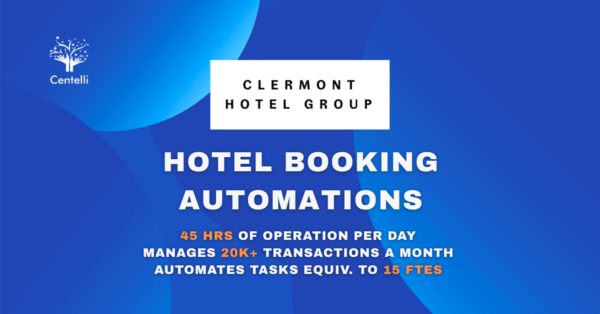
Hotel Booking Automation can be a game-changer for a hospitality business! Bookings and customer experience are core pillars of success in this industry. Guests must keep coming — and leave satisfied. And it all starts with the hotel booking system itself, because a seamless reservation is the first positive impression a guest takes in! However, Clermont Hotel Group was facing dual challenges: fluctuating demand and staffing issues. The pandemic brought unprecedented disruptions too, forcing a rethink. So, they decided to step up and found the perfect solution in automated bookings, powered by a Digital Worker. (It’s a special kind of software built to autonomously tackle repetitive, complex, or high-volume tasks!) Reimagining Clermont’s Hotel Booking System with Digital Workers The hospitality industry is known for its dynamic environment. Hotel companies constantly need to balance personal guest interactions with operational efficiency. Clermont Hotel Group, based in the UK, operates 16 hotels with over 4,000 rooms, more than 100 event spaces, and several bars and restaurants. Now, imagine the scale of operations and the sheer volume of booking inquiries they manage each day. Aiming to streamline their reservation system, the brand reached out to Centelli — and so began their ‘Digital Worker’ journey, which has been remarkably successful. Our team of Intelligent Automation experts designed, developed, and deployed a Digital Worker named Bertie. Key tasks Bertie performs include: The advantages of reduced manual processing, improved accuracy, and heightened staff and customer satisfaction are evident. Keep reading for more insights! 3 Key Benefits of Hotel Booking Automation with Digital Workers Bertie, the Digital Worker, has proven to be an indispensable asset for Clermont, delivering clear and tangible advantages. Here are the top three benefits: 1. Enhanced Data Handling Bertie extracts and verifies all relevant booking information from emails: This minimizes human error and ensures confirmation numbers and payment details are always correct. “Having a Digital Worker as part of the team is fantastic! It takes on the more monotonous tasks, more accurately and efficiently — leaving the rest of the staff to deal with bespoke requests.” Melanie Cole, Head of RSC, Clermont Hotel Group 2. Improved Operational Efficiency The Digital Worker delivers serious efficiency gains in bookings management: This has not only improved efficiency across the guest administration process but also eased our client’s recruitment challenges and helped cut back operational costs. 3. Streamlined Staff Workload and Experience Automation hasn’t just saved time on routine bookings and front desk tasks. With reduced workloads, Clermont’s staff now have more time to engage directly with guests, helping them to: Notably, this also enhances the employee experience and contributes to better staff retention. Setting Up Hospitality Digital Workers and the Cost Factor At Centelli, our Digital Worker solutions are custom-built — and for good reason. Every hotel operation is different, so we tailor these solutions to your exact needs, goals, and operational challenges. In most cases, the Digital Workers integrate seamlessly with your existing systems. While some adjustments may be needed occasionally, we typically work with what you already have. They can also be deployed alongside existing automations to enhance your system’s capabilities and drive even greater efficiency. “We already had some automation within our booking processes, but with so many partners and integrations, there was still a lot of manual data transfer. Centelli worked with us to understand that a Digital Worker could perfectly complement our existing processes.” Chris Ball, Business Development Director, Clermont Hotel Group A New Era of Hotel Booking Automation & Hospitality Innovation The impact Digital Workers have delivered for Clermont Hotel Group is a practical use case of how the right technology can transform your operations. And their value doesn’t stop at bookings! You can also use them for: These are some common examples, but Digital Worker automation is mouldable to many more functions and processes across hospitality. Significantly, with AI integrations advancing, these solutions are set to further reimagine this high-stakes industry. If you’re looking to automate your hotel booking system process or other hospitality operations, feel free to reach out and book a quick, no-obligation meeting today!
How Davidson Hospitality Saved 80% of Finance Team Time with AI, Automation
Davidson Hospitality Group has advanced its digital transformation by implementing AI and automation in its finance function. Partnering with Centelli, the group optimized its reconciliation process, ensuring all financial records are accurate and consistent. With simplified, streamlined process, Davidson’s accounting team can focus on strategic tasks, boosting productivity and enabling better insights that drive organizational growth. Importantly, this digital transformation also aligns with the company’s goal of integrating advanced technologies to enhance service offerings and operational efficiency. The Challenge Notably, Davidson Hospitality manages over 200 hotels, resorts, and restaurants. And it faced the challenge of reconciling financial data from multiple sources on a daily basis. The key ineffeincies included: So, these manual reconciliations, performed via older systems accessed through Remote Desktop, drained valuable time. Consequently, it limited the team’s capacity to drive business performance. How Finance Automation Makes a Difference Centelli’s solution introduced a Digital Worker (DW) designed to emulate human actions on a computer system. It manages tasks like logging into various applications, downloading data from banks, and processing it. Here’s a closer look at what the Digital Worker does: 1. Logins and Data Downloads: The Digital Worker bot securely logs into banking applications and downloads transaction data Then it starts the reconciliation process without human intervention. 2. Intelligent Data Matching: The specialized bot uses a central mapping spreadsheet to efficiently match transactions, interpreting naming inconsistencies and adapting to new data over time. 3. Seamless Integration with Active Systems: Despite the challenges posed by older systems, the Digital Worker adapts easily, ensuring continuous, accurate processing across multiple accounts. Real-World Financial Impact and Benefits of AI and Automation Significantly, the benefits of Centelli’s finance automation for Davidson Hospitality are transformative. If the numbers could speak! We all love our Digital colleague. While we are at home each night, they are working away doing what was the most time-consuming part of my day—reconciliations. This transformative shift empowers our staff to focus on high-impact activities that enhance their skills and drive exceptional business performance! — Kyla Lawson, Senior Corporate Accountant Why You Should Care Because this AI solution is not just an automation tool; it’s a strategic asset that enhances operational efficiency! For Davidson, this technology allows accountants to move away from monotonous tasks and focus on insights that drive the business forward. You may also like: AI in Financial Risk Management: Robust Control & Smarter Decisions You can also empower your finance team and achieve seamless reconciliations with Centelli’s innovative approach. Interested? Get in touch today to learn how we can help you!
Finance Automation Tools: Why Your F&A Team Needs Digital Workers
There are plenty of finance automation tools and platforms out there. So, picking one should be easy, right? Not quite. There’s a lot to consider, such as: Your team needs tools that are both effective and easy to use. So, if you’re looking for a smarter, more adaptive automation tools for finance, Digital Workers can be a good fit. Keep reading to find out why. Why Digital Workers Belong to Your Finance Automation Toolkit Digital Workers are a game-changing addition to finance teams’ tools stack. Interestingly, unlike traditional automation, they learn, adapt, and make decisions. With AI and machine learning at their core, these advanced automation bots can: In contrast, classic automation tools and software typically hit a brick wall with unstructured data and complex decision loops. Problems with Finance/Accounting Software: Digital Workers in Finance: In essence, a ‘Finance Digital Worker’ marks a leap in automation, evolving from rule-driven task execution to intelligent, adaptable, and autonomous process management. Limits of Robotic Process Automation (RPA): Curious how Digital Workers deliver impact? Explore our success stories here. #1 Accountants at Davidson Hospitality Group now work ‘on the business rather than in the business’. #2 Our bot ensures all invoices from the last working day are cleared before this premier vehicle leasing company starts a new day. #3 Our Digital Worker helps this large motor dealership process 5K+ invoices and save 250+ person-hours each month. 5 Benefits of Automating Finance via Digital Workers Proactive, not reactive like software. A dynamic self-learner, unlike static RPA. Equipped with deep analysis, reasoning, and judgment capabilities. Can be autonomous or collaborate seamlessly with people. So much to appreciate and take advantage of in a tool! With Digital Workers by their side, finance teams can focus on strategy, risk assessment, and growth planning rather than grappling with errors, backlogs, anomalies, and compliance. Forrester defines digital worker automation as a blend of intelligent automation (IA) components, including conversational intelligence and robotic process automation (RPA), designed to work alongside employees. These digital workers comprehend human intent, respond to inquiries, and take action on behalf of users—while ensuring humans retain control, authority, and an enhanced experience. Source: IBM Top Benefits of Finance Automation Digital Worker(s): Custom Finance Automation Tools: Smart Investment or Hassle? Why use custom process automation tools? One simple reason: to get exactly what you need! Since we’re talking about Digital Workers, consider the following reasons in their context: 1. One Size Doesn’t Fit All A grocery chain’s finance processes are vastly different from a bank’s. Can you compare an NGO’s operations with those of a hotel group? Obviously not. Therefore: 2. Customization Improves Efficiency Digital Workers are persistent, ongoing presences in workflows. With customization, they: 3. Trained to Desired Autonomy level As mentioned earlier, a Digital Worker can be: 4. Maximized Automation Impact A well-designed custom digital Worker delivers value through: Building your own Digital Worker may seem like a hassle at first. But consider the trade-off—streamlined workloads, greater efficiency, and a finance team free to focus on high-value tasks. For modern finance teams and CFOs, innovative automation solutions are no longer a choice. Their success depends on embracing an evolving environment where technology and humans work seamlessly together. Want to build your customized Finance Digital Worker with a trusted UiPath automation provider? Book a no-strings-attached meeting with our expert today.
AI in Financial Risk Management: Robust Control & Smarter Decisions

The finance sector is evolving rapidly with artificial intelligence (AI) is at the forefront of this transformation. Financial institutions and organizations are increasingly relying on AI to manage risks, improve decision-making, and ensure compliance with ever-changing regulations. This article delves into the pivotal role of AI in financial risk management, highlighting key use cases that demonstrate its transformative impact on the industry. Furthermore, it also discusses the potential challenges along the way and emphasizes why balancing innovation with best practices is critical for successful and responsible AI implementations. AI is Transforming Finance Industry Landscape Traditional financial systems often relied on historical data and manual processes to evaluate risks. But the classic ways are inadequate in today’s fast-paced, digital and data-driven world. Here, AI has introduced advanced predictive models and real-time analytics. AI-driven algorithms can now assess credit risks, detect fraudulent activities, and analyse market trends with unprecedented speed and accuracy. We’ve been helping companies to leverage AI and Automation in financial services for over a decade. Not only does it enhance your operational efficiency, but it also creates a more robust framework for risk management. AI is emerging as the first line of defence for risk identification, assessment, prediction, and mitigation in the modern financial ecosystem. However, financial institutions vary widely, including banks, insurers, asset finance companies, investment firms, brokerages, and fintech firms. So, a cookie-cutter approach doesn’t work! AI-powered risk management tools and applications are being tailored to specific needs. Enhancing Risk Assessment with AI One of the key benefits of integrating AI into financial processes is its ability to process vast amounts of data. Machine learning models can identify patterns and anomalies that may be invisible to human analysts. The following examples illustrate the diverse applications of AI in risk assessment and management: AI and Risk Management: Balancing Innovation and Ethics While the benefits are substantial, implementing AI in finance also brings some challenges. For instance, data privacy, algorithmic transparency, and potential biases in machine learning models remain concerns. Furthermore, financial leaders must ensure that AI solutions are not only effective but also ethically sound and legally compliant. As financial institutions continue to embrace AI, the role of technology in managing risks will only expand. The integration of AI-driven tools offers the promise of proactive risk management, where potential issues are identified and mitigated before they escalate. Statista So, whether it’s product development, data handling, customer service, or risk management, financial organizations and institutions must approach AI adoption with diligence, a proper roadmap, and ethical considerations. This ensures they can mitigate potential challenges and responsibly harness AI’s capabilities to their advantage! Through all our Automations, we at Centelli emphasize the importance of a balanced approach—one that integrates innovative technology with robust governance and risk controls. This philosophy drives our Automation and AI solutions that we craft for our clients. The Future of AI in Financial Risk Management AI is reshaping finance, offering powerful tools for risk management that enhance both accuracy and efficiency. With continuous advancements and a focus on ethical implementation, AI stands to revolutionize the financial industry. You May Also Like: The First Steps to Leveraging AI in Finance Operations By following best practices and leveraging expert insights, organizations can navigate the complex financial landscape with greater confidence and resilience! Organizations willing to invest in these technologies today will be better positioned to manage risks and capitalize on new opportunities in the future. Book your meeting with our experts now
High-Performing Finance Teams: Unlocking Efficiency and Impact with Intelligent Automation
High-performing finance teams are the cornerstone of business success. However, even the most effective teams must evolve to continue their dream run. Systems become obsolete, processes grow stale, and inefficiencies creep in—and there’s no escaping the shifts brought by modernization and digitalization. So, you may need to reimagine your operations, enhance processes, improve workflows, and adopt better tools to keep achieving great results. Intelligent Automation (IA) can be a significant force multiplier for finance departments across roles. Think of IA as an ally, enabler, and amplifier—helping your team stay at the top of its game! High-performing finance teams are efficient, accurate, and fast-moving. They excel with strong analytical skills, the ability to use data effectively, and close collaboration. Intelligent automation can significantly enhance these capabilities, providing the tools and resources to become even more effective. Download our free guide “AI and Automation in Finance Teams,” featuring key insights and our real-world case studies. 5 Big Performance Blockers for Finance Teams There are two possible scenarios: If you are striving for a high-performing finance team, it’s important to identify and overcome the challenges and barriers that are stopping you. The most common performance blockers for finance teams include: You commonly see accountants working endless hours on data entry, updating, reconciling, or preparing reports. As boring and uninspiring as it is, errors and oversights are quite likely. These low-value yet time-intensive activities distract your team from more strategic tasks. Growing data volume is already a significant challenge, but navigating multiple data sources (e.g., CRM, ERP, PPM) can truly overwhelm your finance team, especially with archaic data management tools requiring manual processes. This makes tracking, reporting, and ensuring compliance a constant struggle. Slow processing, reworks, heavy workloads, and resource crunches can derail schedules and deadlines. Sudden assignments only add to the pressure. Not just routine tasks like monthly reporting and payroll—critical tasks like sales tax filings and audits can also drag on, increasing compliance risk. The Intelligent Automation revolution is here. This third wave of digitization and generative AI enables businesses to integrate unstructured content with analytical AI’s structured data capabilities. We can see massive productivity gains, particularly in finance operations, a report apprises. Financial information comes in diverse formats, and traditional systems may not be equipped to handle unstructured data like text documents, emails, images, and videos. Inconsistencies prevent an accurate, holistic view—a common issue with data silos and manual processing. Communication gaps among finance team members and with other departments can be a recipe for delays, errors, and poor decisions. Without collaborative workflows and real-time data, your team faces gaps, confusion, and outdated information. Tasks take longer, and overall efficiency declines. Intelligent Automation: Key to High-Performing Finance Teams Finance and accounting teams at every level can thrive with intelligent automation. Automated processes and AI tools help employees work quickly and accurately. Key Highlights: Wondering how it may pan out for different roles? 1. Finance Analysts/Accountants: Do More, Do Better—and Faster How? Freedom from mundane work. More exposure to value-add, strategic tasks enables upskilling and learning. Key Use Cases: Data Entry, Document Processing, Transaction Processing, Reconciliations, Report Generation, etc AI and Automation were the top CFO Priorities in 2024. We provide customized AI solutions crafted using the right tools and technologies to meet your exact operational needs. If you’re looking for Intelligent Automation solutions that deliver real impact and value, speak to us. Schedule your call here. 2. Finance Managers/Supervisors – Uplift Team Efficiency and Performance How? Empowers mid-tier managers to lead teams more effectively. Facilitates process innovations, helping them step into more strategic roles. Key Use Cases: Document Processing, Workflow Automation, Dashboards, Reports & Analytics, Process Mining, etc. 3. CFOs and Controllers – Boost Strategic Decision-Making & Outcomes How? Helps finance leaders position finance team as a strategic asset. And drive financial excellence and digital transformation, and business growth. Key Use Cases: Customized Reports, Data Visualization & BI, Predictive Analytics, Financial Risk Assessment, etc. Real success stories from our clients: Case Study: Our Automated Invoice Reconciliation solution has improved financial visibility for this automotive dealership group, improving decision-making. Case Study: This Atlanta-based healthcare provider leverages our Digital Worker for billing, records, and finance. It enhanced accuracy and efficiency while staying HIPAA compliant! Ready to transform your finance team with Intelligent Automation? Book Your Meeting Now! Key Takeaways Intelligent Automation is becoming a critical success driver for high-performing finance teams.