
Onboarding, Contract Management, and Policy Compliance
Streamlining HR Processes with Digital Workers Human Resources (HR) departments are under increasing pressure to enhance efficiency and ensure compliance while managing a growing workforce. Digital workers, powered by intelligent automation, are transforming HR by streamlining key processes such as onboarding, contract management, and policy compliance. Here’s how: The Challenges in HR Management HR departments often grapple with labour-intensive and repetitive tasks, which can lead to errors, inefficiencies, and delays. Managing HR processes are not only time-consuming but also prone to inconsistencies – in areas that really must be consistent to ensure fairness across a workforce. Key challenges include: – Onboarding: Coordinating between various departments to ensure new hires have access to necessary tools, information, and training. This may include documentation requirements, IT requirements, system access etc. – Contract Management: Keeping track of contract terms, renewals, and compliance with legal requirements. – Policy Compliance: Ensuring that all employees adhere to company policies and regulatory standards and managing policy updates effectively. How Digital Workers Transform HR Processes 1. Onboarding Digital workers significantly streamline the onboarding process by automating various tasks: – Document Collection and Verification: Digital Workers can create, collect, verify, and store essential documents, reducing the manual workload and ensuring accuracy. – System Access Coordination: They can coordinate tasks across departments, ensuring new hires have access to necessary tools, accounts, and resources from day one. For example, Digital Workers can handle the creation (and then deletion) of all new accounts across tools such as Microsoft 365, other email platforms, social media, CRMs etc. – Personalised Training Schedules: Digital workers can create and manage personalised training schedules, ensuring new employees receive all required training without delays…and all completed training is logged centrally (for example if it’s a requirement). These improvements lead to faster onboarding, better new hire experiences, and a more organised approach to welcoming new employees. 2. Contract Management Managing contracts effectively is crucial for compliance and operational efficiency. Digital Workers can automate several aspects of contract management: By automating these tasks, HR departments can reduce errors, save time, and maintain better control over contract management. 3. Policy Compliance Ensuring policy compliance is a continuous challenge, especially as regulations and company policies evolve. Digital Workers help maintain compliance by: This automation leads to improved compliance rates, reduced risk of non-compliance, and a more organised approach to policy management. Case Study: Enhancing HR Efficiency with Digital Workers A global financial services company implemented digital workers in their HR department to streamline onboarding, contract management, and policy compliance. The results were impressive: These improvements not only enhanced HR efficiency but also contributed to better employee experiences and reduced operational risks. Conclusion Adopting Digital Workers in HR is not just a trend but a necessity. By automating repetitive tasks and ensuring better compliance, digital workers help HR departments focus on strategic initiatives, improve efficiency, and enhance overall employee satisfaction. As businesses continue to evolve, leveraging intelligent automation in HR will be key to staying competitive and agile. For more insights on implementing digital workers in your HR processes, take a look at this page! Book a meeting with us today to talk through how we can solve your HR needs!
Outsourcing Accounting Services for Small Businesses: Key FAQs Explained

Outsourcing accounting services for small business has become common nowadays. It presents a practical and cost-effective solution to streamline your accounting function, remove its bottlenecks, and improve productivity. Yet, some small business owners remain hesitant to adopt this strategy. They are usually unsure how accounting outsourcing will fit into their overall operations or unaware of how it can improve their bottom line. So, let’s delve into some frequently asked questions about accounting outsourcing to address some of the key concerns you might have if you are a small business owner! Should I Outsource My Accounting for Cost-Effectiveness Only? No, you don’t have to do it just because you’re in a financial tight spot or for cost-effectiveness alone. Outsourcing can be much more rewarding beyond this one most highlighted advantage. You can choose to outsource your accounting department to streamline your overall business operation by shedding off less important tasks in favor of high-value core tasks. And this will allow you to focus on your ‘money processes’ that bring in the revenues and profits. Unconstrained by everyday involvement and management of accounting tasks, your team can go full throttle chasing your business goals. Surely, you’ll appreciate it so much if you’re able to do so. Not to mention, recruitment and retention are becoming ever more challenging. You might have observed and experienced the worldwide shifts happening in work cultures, employer and employee expectations post Covid-19 global pandemic and ‘great resignation’ phenomenon in the United States. As such, companies are finding it harder to source qualified, long-term accounting and bookkeeping staff amid labor shortages and wage spirals. Furthermore, digitalization and automation are rapidly transforming work environments. And your business must align with the evolving technological landscape to stay competitive! However, it can be daunting to keep up with the latest accounting software, technology infrastructure, and trends on your own if you’re a small company. How Outsourcing Accounting is Beneficial for Small Business? Small team, limited resources, long hours, fluctuating workloads and many more challenges! You know the drill if you’re a small business owner. Kudos for managing it all so incredibly. However, rising operating costs and a evolving accounting & compliance landscape can throw you off balance even when you’re trying your best. Notably, time management, stress, and burnout are some key issues many small business owners grapple with. Of course, when you are a lone wolf or have a small team, it can be difficult for you to manage your time and focus effectively. So, you should re-think keeping it all in-house and consider outsourcing! Also, outsourcing enables you to leverage the best technologies without making any hefty investments. This is especially useful when your small business is braced for a scale up or expansion. Therefore, when you have a trusted and expert outsourced service partner to take care of your accounting, you are covered for at least this area of your business operations. I’m Looking to Outsource Accounting! What Services Do Accountants Provide to Small Businesses? Accounting services can range from basic bookkeeping to complex financial processes. Some accounting outsourcing firms provide end-to-end services while others offer selective expertise. Besides, some accounting service outsourcing providers handle only industry-specific accounting tasks. Therefore, you need to look out for this and any specific needs of your business when choosing an accounting services partner. Following are the eight commonly outsourced accounting services for small businesses: How Much Does It Cost to Outsource Small Business Accounting Services? The cost of outsourcing accounting services for small business can depend on many factors. These include the size and complexity of operation, the range and level of services availed, customization for unique needs, expertise and service quality of the service provider, bundled services, discounts offered, etc. Outsourcing typically results in significant cost savings compared to hiring a full-time accountant. Nevertheless, when evaluating outsourcing options, it’s crucial to consider the overall value proposition rather than solely focusing on upfront costs. Usually, cost-effective access to skills and expertise, time savings, and risk mitigation benefits outweigh the initial investment, making outsourcing a worthwhile decision for many small businesses. Outsourcing accounting can halve your costs spent on an in-house operation, depending on the range and type of services used. This can result in significant savings for your business. Save up to 35-60% when you outsource accounting services from Centelli. ‘Your peace of mind’ is among the key benefits we pack in. Book a free Consultation today! How to Decide on Outsourcing Accounting Services for Small Business? Outsourcing your accounting process to an external service provider is the right decision for your business depends on several factors, including: Using Centelli’s Accounting Outsourcing Services can be your most pivotal move to uplift your small business efficiencies in sure-fire ways. Reach out to us for a free consultation. In Summary Many small business accountants work online or remotely on an hourly basis to handle tasks such as transaction recording, compiling the chart of accounts, maintaining the general ledger, month-end closing, preparing trial balances and financial statements, and even conducting financial analysis. Outsourcing accounting services for a small business can be great move. There are no fixed overhead expenses for in-house resources, and there is no need for daily supervision as your external accountant expertly handles everything. So, you can save on both time and money and invest them in growing your business!
How Digital Workers Solve Businesses’ Biggest Challenges
Whilst some say that every company faces unique challenges, there are certainly some commonalities that almost all businesses face today. Among the most pressing (and more common) are 1) the recruitment & retention of great talent, 2) meeting higher customer expectations, and 3) reducing operational costs. Fortunately, Digital Workers offer solutions to all three challenges, helping businesses thrive. Here’s how Digital Workers solve businesses’ biggest challenges: 1. Recruitment of New Talent Enhancing Employee Satisfaction By offloading mundane tasks to Digital Workers, current employees can engage in more fulfilling and meaningful work. This not only boosts their job satisfaction but also their productivity. Happy employees are more likely to stay with the company longer, reducing turnover rates and the associated costs of hiring and training new staff. Moreover, employees who are free from monotonous tasks can contribute to innovation and drive the company forward. Reducing the Need for New Recruits Finding and hiring new talent is often a time-consuming and costly process. Digital Workers, equipped with intelligent automation, not only help your retention as outlined above, but they can also take over repetitive and time-consuming tasks, reducing the need for businesses to hire additional staff. They can efficiently handle tasks such as data entry, report generation, and routine customer inquiries, allowing human employees to focus on more strategic and creative aspects of their roles. 2. Higher Customer Expectations Faster and Better Service Today’s customers demand quick and high-quality service. Digital Workers can operate 24/7, ensuring customer queries and issues are addressed promptly, even outside regular business hours. This level of responsiveness is crucial in maintaining customer satisfaction and loyalty. By handling routine inquiries, they free up your team to focus on complex customer needs, providing a more personalized and human touch where it matters most. Enabling Staff to Focus on Customers With Digital Workers managing repetitive tasks, human employees can spend more time building customer relationships. This shift allows staff to understand better and anticipate customer needs, leading to improved customer experiences. Enhanced customer interactions often result in positive reviews and referrals, driving business growth. 3. Cost Reduction Increasing Operational Efficiency Digital Workers are highly efficient and capable of performing tasks faster and more accurately than their human counterparts. This efficiency translates to significant cost savings. For instance, in finance departments, Digital Workers can streamline invoice creation, expense management, and financial reporting processes. This reduces the time and resources required for these tasks, lowering overall operational costs. Minimizing Errors and Compliance Risks Human errors can be costly, especially in industries with stringent compliance requirements. Digital Workers minimize these risks by performing tasks with high precision and consistency. In sectors like construction, for example, Digital Workers can handle VAT and CIS processing with minimal errors, ensuring compliance and avoiding costly fines. This reliability further contributes to cost savings and enhances the company’s reputation. Conclusion Digital Workers are revolutionising how businesses operate, solving the biggest challenges companies face today. By reducing the need for new recruits, enhancing customer service, and cutting operational costs, Digital Workers enable businesses to operate more efficiently and effectively. Embracing intelligent automation drives immediate benefits and positions companies for long-term success in a competitive market. As businesses continue to navigate the complexities of the modern world, We provide a robust solution that supports growth, innovation, and customer satisfaction. It’s time for companies to step into the future and transform their operations for sustainable success. Actively serving the UK, Europe, US, and India, we’ve now expanded our Intelligent Automation, Digital Worker, and RPA offerings to Dubai, UAE too! To learn more about how we can help your business or department, contact us now.
How Outsourced Bookkeeping and Accounting Saves Your Business Money

Outsourced bookkeeping and accounting can be highly productive and cost-effective operation when done right! The key lies in identifying which tasks can be assigned to an outsourced bookkeeping and accounting services firm. Whether to outsource end-to-end or selectively as well needs careful deliberation. Both strategies can effectively help business expense management and cost control. So, whichever path you take, ensure it aligns with and serves your business needs, budget, goals, and purpose. Outsourced Bookkeeping and Accounting: Cost Reduction vs Cost Savings Picture your accountants and bookkeepers busy creating lists of expenses for buying new equipment and machinery for a new manufacturing unit. Or your accounting team preparing quarterly revenue reports when your service business has achieved double-digit growth. Impressive, isn’t it? Of course, it’s not a good idea to randomly fire your good employees or ignore investing in the best accounting software, which can improve accuracy and speed. However, you should not hesitate to eliminate unnecessary expenses from your accounting department. They could be: Simply put, you are cutting off wasteful and unproductive expenditure, which outsourcing can also help you accomplish with minimum effort. Further, cost saving as well is an important decision for any business. It means using resources optimally and effectively. Let’s take an example. You can skip capital expenditures on building or expanding an internal accounting department when you hire outsourced services. The money saved can be used on other strategic initiatives, such as research and development, improving customer service, or paying back your bank loan. Every business wants to keep its expenses in check—outsourcing can help you save significant amounts. Types of Costs You Save with Outsourced Bookkeeping and Accounting Now, let’s dive into the types of costs you can eliminate or reduce when you outsource your accounting-related tasks. As of May 2022, bookkeeping, accounting, and auditing clerks earned a median annual wage of $45,860, according to information from the US Bureau of Labor Statistics. As per the UK’s National Careers Service, an experienced bookkeeper’s salary in the country is about £35,000. Notably, you can get the work done at a much lower cost using expert outsourced accounting services. The same workload processed at a much lower cost while maintaining the quality! But labour costs are just one part. Also, consider the capital expenditure saved on infrastructure and the operating expenses saved on employee salaries, training, office rentals, equipment, supplies, and other errands associated with maintaining an internal accounting department. So, you can see why outsourcing provides an excellent gateway to cost reduction and cost savings. Additionally, outsourcing with offshore services located in a country with lower labor costs can save you even more! You can save up to 35-65% on costs and reclaim your focus and time for core business activities when you hire Centelli’s F&A services. We are one of the fastest-growing outsourced bookkeeping and accounting firms in Atlanta, USA, with another branch and global delivery centers in Panchkula, India, and our headquarters in London, UK. Schedule your free consultation today! Outsource for Cost-efficient, Scalable Accounting and Bookkeeping Ops Suppose your company is breaking into new markets rolling out new branches. You will expand your supplier network and obviously the customer base. Which means your accounting operations will also scale up and become more complex. As such, you will have to hire more accountants and bookkeepers. You may also need to create more office space and buy new computers and devices. Upgrade your accounting software subscription to accommodate more team members as well? So, you might end up spending a significant amount of upfront costs even before you’ve started. Well, you can save all that money to fund your marketing and sales activities or product innovation and improvement – outsourcing provides a cost-effective alternative to an in-house operation. However, a sole focus on cost-cutting can be detrimental to the productivity, quality, and outcomes of your in-house or outsourced processes. Unless your business is in a state of extreme difficulty caused by unfortunate events such as loss of revenue, failure of a product or project, or economic decline, consider carefully which costs are productive and which are not. But when you’re struggling, you have no choice but to cut costs. Additionally, you might also need to reduce expenses during the lean or off-season. Laying off your staff or temporary hires or stalling infrastructure spendings becomes inevitable in that case, too. However, the “hire and fire” strategy may not always be the best approach. It can disturb your accounting department processes and budgets. It can also harm your brand image in the long run. Re-hiring can be challenging, furthermore! Likewise, the costs of infrastructure expansion may rise in the future, adding to the overall cost burden. Fully Outsource or Build a Hybrid Accounting Team Accounting and bookkeeping services outsourcing allows for a flexible and adjustable process that can meet your changing business needs. It’s more cost-effective and flexible to outsource a department rather than manage it in-house, as restructuring is difficult and infrequent in the latter case. However, you must look for the best outsourced accounting and/or bookkeeping services available for optimal results! However, you must look for the best outsourced accounting services and/or bookkeeping services out there for optimal results! Remember, you can always build a hybrid accounting or bookkeeping operation blending in-house and outsourced accounting teams if you want. You retain complete control over processes you don’t want to hand over while benefiting from external specialist expertise. That’s another significant advantage outsourcing provides! Closing Note No matter which industry you operate in, all businesses want to control their unwarranted expenses. And it has nothing to do with frugality and stringency. Every dollar saved or spent strategically can contribute to your business growth! One potent method of streamlining your operations is to outsource non-core processes like accounting and bookkeeping. This approach provides a noticeable cost benefit and delivers numerous intangible advantages. So, if you’re thinking about signing up with an outsourced accounting and bookkeeping service, select a skillful service provider with a solid reputation. Connect with Centelli here!
Upgrading Your Legacy Systems: Essential Guide

If Someone’s Told You to Upgrade a Legacy System – READ THIS before Doing Anything Else! In many modern businesses, where speed and efficiency are not just desired but essential, the legacy systems often loom large. These systems, once the backbone of your business, may now feel like anchors, slowing you down in the race towards digital transformation and improved productivity. And when the recommendation for overhauling or completely upgrading your legacy systems, it’s accompanied by visions of exorbitant costs and extended timelines. But what if there’s a solution that saves you time, budget, and the value of what you already have in place? This is where the conversation with Centelli becomes crucial. Centelli champions an alternative to legacy system replacement – with Intelligent Automation (IA), an advanced solution that breathes new life into legacy systems whilst improving overall productivity, often even more than a new system would. Unlike the traditional, often disruptive method of system overhaul, IA integrates seamlessly with your existing infrastructure, enhancing its capabilities without requiring extensive replacements. This approach is not just about preserving what works; it’s about elevating it to meet contemporary demands whilst simultaneously freeing up staff to undertake more value-added activities. Let’s talk a little more about HOW…! The Misconception of Necessary Overhaul The prevailing wisdom suggests that to stay competitive, businesses must discard the old and usher in the new. This narrative, while sometimes true, often overlooks the potential of enhancing existing systems. This article from Hospitality Net underscores the challenges businesses face with legacy systems, particularly in sectors like hospitality where customer satisfaction is paramount. However, it also opens the door to a significant realization: the need for smarter, not necessarily brand-new, solutions. Intelligent Automation: The Game Changer Intelligent Automation stands at the intersection of artificial intelligence and robotic process automation (or RPA). It’s not just automation; it’s automation with a brain. IA can understand, decide, and learn from the data it processes. In the context of legacy systems, this means IA can integrate with your current setup, automate routine tasks, streamline operations, and provide analytics and insights without the monumental costs and downtime associated with system overhauls. Real-World Applications in Construction In sectors like construction, where Centelli has vast expertise, the application of IA proves its transformative potential. Managing subcontractor onboarding, VAT and CIS processing, cost monitoring, invoice creation, and vendor management are all areas fraught with complexities and ripe for errors. IA introduces precision, speed, and reliability into these processes, significantly reducing the margin for error and the time consumed by these tasks. Cost and Time Efficiency One of the most compelling arguments for upgrading your legacy systems with Intelligent Automation is its cost-effectiveness and rapid deployment. Implementing IA solutions is a fraction of the cost of system overhauls, with much shorter timelines. This means businesses can start realizing the benefits of digital transformation sooner, without the financial strain typically associated with such initiatives. Future-Proofing Your Business The most overlooked advantage of Intelligent Automation is its scalability and adaptability. IA solutions can be adjusted to accommodate new processes, regulations, and technologies as your business grows and evolves. This flexibility ensures that your investment today continues to pay dividends well into the future, safeguarding your business against obsolescence. Conclusion Before signing off on a costly and time-consuming system upgrade, consider the alternative Intelligent Automation offers. Centelli’s ability to seamlessly integrate IA with legacy systems presents a compelling case for re-evaluating how we approach digital transformation. By choosing a path that is not only more cost-effective and efficient but also adaptable and future-proof, businesses can navigate the digital landscape with confidence and agility. Speak to us today and discover how your legacy systems can become a launching pad for your business’s next chapter in innovation and growth.
Why You Need a Scalable Accounting Process [with Examples]
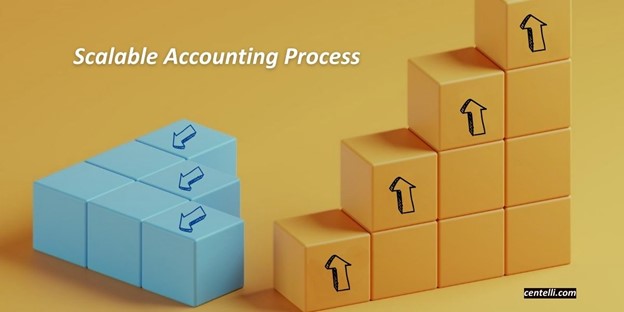
Business is a dynamic field full of opportunities, challenges, and uncertainties. With a scalable infrastructure, technology, or operation, it’s easier to navigate the change. So, you can also build a scalable accounting process for the same reason! Before we delve into the reasons for scaling your accounting operations, let’s define the concept first. Well, “scalability” is not a function or a feature by itself. It represents a fundamental characteristic that empowers an organization, system, or process to effectively manage heightened workloads, increased demand, or expansion. Scaling Your Accounting Process Doesn’t Imply a Scale Up Always A business’s full cycle accounting needs can evolve due to both external and internal factors. External triggers could be changing market conditions or evolving regulations. Whereas your shifting business goals and priorities signify the internal triggers. Therefore, you should be able to adapt your accounting tasks and workflows to accommodate unexpected events or planned strategic initiatives. Markedly, scaling doesn’t always mean upsizing or increasing your capacity. You may also need or choose to hold back sometimes. Let’s look at some scenarios for clarity! There are times when a company needs to expand its accounting team. The reasons could be: Following reasons could compel a business to downsize its accounting department: How the Scaling of an Accounting Process Might Look Like Let’s look at three examples of when and why a business needs to readjust or realign its accounting operation. Case 1: Restaurant Business Scaling its Accounting Process A small restaurant chain with 10 locations plans to add five new locations in the next 12 months. It will be hiring new staff, expanding its menu, adding more suppliers, and investing in accounting software and technology upgrades. However, it may need to scale down its accounting process if it is closing locations or experiencing a decrease in sales. Case 2: Fashion Retail Business Scaling its Accounting Operation A fashion retailer operates 50 offline stores and an e-commerce shop nationwide. It may need to scale up its accounting function if it is launching a new product line, expanding into new markets, or raising funds for expansion. On the contrary, the fashion chain may be forced to scale down its accounting activity if it is discontinuing a product line, seasonal demand loss, or closing stores. Case 3: Accounting or CPA Firm Scaling its Client Accounting An accounting/CPA firm (size regardless) may need to scale up its client accounting process if it is taking on new clients or expanding its service offerings. The firm might also require additional resources to handle the high workload of the busy tax season and specific projects. However, the firm may need to cut back on its accounting operations if it is losing clients or experiencing a decrease in demand for its services due to economic downturn or other reasons. Challenges of Scaling In-house Accounting A scalable accounting process is designed to be flexible enough to meet the changing business needs. This way, it’s easier to sustain or enhance its performance, efficiency, and capacity as required. However, building an in-house scalable accounting workflows can be challenging due to the following reasons: Scaling up your in-house accounting often requires significant capital investment and additional resources. Conversely, scaling down can lead to underutilized staff and wasted efforts. Thankfully, accounting outsourcing provides a flexible and cost-efficient solution in both scenarios. Outsource Your Way to Scalable Accounting Hiring a third-party accounting service brings in so many advantages: Need a flexible accounting process that adapts to your changing business needs? You can easily achieve a scalable accounting process by outsourcing with Centelli, saving you the hassle and high costs of in-house operation. Get your free consultation today! The Bottom Line All organizational systems and should be able to adapt to the changing business needs. A scalable accounting function ensures efficiency and supports strategic decision-making, all while managing costs and risks effectively. So, whether you have an in-house function or choose to outsource your accounting, you may need to scale it at some point.
There’s more to AI than tools like ChatGPT, Gemini and Copilot
If your business is only using AI via ChatGPT / Gemini / Copilot, you’re Missing the Biggest Opportunity! We get it: AI tools like ChatGPT, Gemini, and Copilot have become synonymous with innovation and efficiency. Chances are you have tried them yourself, probably to write an email, blog, or social media post—spurred on by the numerous articles about how they will revolutionise every business. Essentially, they have revolutionised how individuals interact with information, automate tasks, and enhance productivity. However, if your business’s engagement with AI stops at these three (or similar) tools, you are merely skimming what’s possible. The real game-changer lies in leveraging Intelligent Automation (IA) at an organizational level, a domain where Centelli excels and transforms businesses. Beyond Individual Efficiency to Organizational Transformation ChatGPT and its counterparts are powerful tools for individuals, offering impressive capabilities from drafting emails to coding assistance. However, when it comes to scaling these benefits across an entire organization, individualized AI tools show their limitations. They operate in silos, benefiting single users without amplifying these advantages across departments or processes. This is where Centelli’s Intelligent Automation solutions come into play, turning isolated efficiencies into organizational productivity gains…and at a MUCH bigger scale! Uber uses this type of automation to save $22m per year, with a 350% ROI. But this technology can help at a much larger scale. We work with companies of all sizes and in various sectors—see some of their stories on our case studies page. The Centelli Difference: IA in Action Centelli’s approach with IA is not about incremental improvements but removing repeatable processes. By automating core business processes, Centelli enables companies to achieve unprecedented levels of efficiency and accuracy. Let’s delve into some specific examples of where Centelli’s IA solutions outshine individual AI tools: Onboarding and Offboarding Invoice Processing Cost Monitoring Vendor Management Super-Scaling Efficiency Conclusion While tools like ChatGPT, Gemini, and Copilot are valuable for individual tasks, they represent just the tip of the AI iceberg. Centelli’s Intelligent Automation solutions unlock AI’s full potential, super-scaling efficiency, and fundamental transformation of business operations. By embracing IA, businesses can leapfrog from incremental gains to monumental achievements in productivity and innovation. Don’t let your business settle for the basics when a world of opportunity awaits with Centelli’s IA solutions—contact us today!
Implementing Intelligent Automation Into Your Workplace
If you’re planning on implimenting Intelligent Automation into your workplace now or in the future, you’re going to want to read this one stop shop of Intelligent Automation FAQs For All Departments.
Intelligent Automation in Healthcare

Injecting Intelligent Automation in Healthcare Today; Enable Positive Growth Tomorrow. A recent McKinsey report1 sheds light on the transformative potential of Intelligent Automation in healthcare today, poised to revolutionise the industry by delivering unrivalled efficiency, speed, and customer satisfaction improvements. Healthcare and Technology. At Centelli, we resonate with McKinsey’s perspective on the healthcare delivery side’s bright future. Financial performance is set to rebound owing to strategic transformation efforts, mergers and acquisitions (M&A), and revenue diversification. The crux of this transformation lies in the adoption of new technology. However, our experience at Centelli is that the vast majority of transformational technology projects are too often focused on new systems and processes. If that is what is required, how will businesses free up the resources needed to drive such change? Healthcare and Intelligent Automation Intelligent automation is critical. We have witnessed firsthand how automation technologies can streamline operations, reduce errors, and free up valuable time for healthcare professionals to focus on patient care and broader business improvement. By automating routine tasks, such as data entry, appointment scheduling, and patient records management, healthcare providers can significantly reduce operational time and costs. Centelli’s Role in Automating Healthcare Businesses Our work in the healthcare sector exemplifies the transformative power of intelligent automation. By implementing our solutions today, businesses can streamline their processes immediately and unlock new opportunities for growth and innovation. Our approach, centred on understanding the unique needs of each healthcare provider and tailoring our solutions accordingly, has resulted in measurable improvements in operational efficiency and customer satisfaction in weeks rather than months or years. As the healthcare industry moves into 2024 and beyond, the importance of technology adoption will be key. The McKinsey report provides a compelling outlook on the potential for healthcare businesses to thrive by leveraging technology to drive medium-term improvements for their customers. At Centelli, we are committed to leading this charge, empowering healthcare providers to navigate the complexities of the modern healthcare landscape quickly and efficiently. Automation and Risk Mitigation In addition to the above, automation can also play another key role in risk management. We have been watching with interest the news about the cyberattack on technology company Change Healthcare and the impact that it has had. And there is no doubt that these attacks continue to be a risk, increasingly so it would appear within the US Healthcare sector. Intelligent Automation can help here too, to help businesses recover from such events and help you get back on your feet quickly when unforeseen issues arise. Thus, Automation can be a part of risk planning/mitigation and needs to be an important strategy that your team considers. Conclusion Healthcare’s future is inextricably linked to the adoption of intelligent automation. As Centelli continues to pioneer this transformative journey, we remain dedicated to delivering solutions that not only meet but exceed our clients’ expectations, ensuring a brighter, more efficient, and patient-centric healthcare system for all. Contact us today to learn more about how we could help your healthcare (or other) business.
Combating The Spread of Misinformation

4 Ways Automation Can Safeguard Democracy: Combating Misinformation Spread