
How Digital Workers Can Pick Up the Slack as Birth Rates Decline

The Challenge of Declining Birth Rates Since 2008, birth rates have been declining, which may cause concerns in several areas, including the business sector. To begin, according to an article in the Atlanta Business Chronicle published in February 2023, higher education leaders are anticipating an enrollment cliff. This will result in a projected decline of 15% in college students by 2025. The effects of this decline will not be limited to universities, of course. It is expected to later result in a workforce cliff and potential labor shortage. Today’s workforce comprises two relatively large generations- baby boomers and millennials- with the smaller Generation X in the middle. Moving forward, two smaller generations will sandwich the millennials, resulting in a significant population gap in the workforce. The Role of Automation in Addressing Workforce Challenges To address this challenge, businesses will need to explore new ways of optimizing their workforce and operations. One potential solution is automation. Repetitive and rule-based tasks that typically require human workers can be automated. This will reduce the workload of human employees and free them up to focus on value-added activities. This approach would allow businesses to reduce the required number of human employees while also addressing the issue of lost workdays and time wasted by employees who are not engaged in their jobs. Introducing Digital Workers Digital Workers, our name for Robotic Process Automation (RPA), are one type of automation that can be deployed across many industries. They can automate a wide range of tasks, including data entry, report generation, and even more complex jobs such as customer support and email management. By handing these over to Digital Workers, businesses reduce the time and manpower needed for their operations, making them more equipped to face a labor shortage when the time comes. Moreover, repetitive tasks cause companies to lose thousands of workdays annually. Up to 20% of employees report wasting time due to disengagement in their jobs, which further exacerbates the issue. However, by implementing Digital Workers, businesses can automate these monotonous tasks. This allows employees to concentrate on more stimulating and rewarding work, ultimately leading to higher job satisfaction and increased overall organizational efficiency. Digital Workers can be deployed across many industries, including healthcare, hospitality, and manufacturing. Centelli’s Digital Workers are suitable for any task that doesn’t necessitate decision-making. They are designed to work non-stop and without breaks, ensuring consistent performance and heightened accuracy compared to human workers. Partner with Centelli for Digital Workforce Transformation In conclusion, the birth rates decline presents a significant challenge for businesses worldwide. However, by harnessing Centelli’s expertise, organizations can transform this challenge into an opportunity. Automating tasks with Digital Workers improves efficiency, reduces errors and costs, and frees up employees for value-added tasks. As RPA technology evolves, it promises to become even more efficient and intelligent, offering a sustainable solution for businesses across diverse sectors. At Centelli, we recognize the urgent need for businesses to adapt to the changing workforce landscape. Our team is committed to helping organizations optimize their operations and overcome workforce challenges. We guide you through the entire process of design, development, deployment, and maintenance of Digital Workers. Don’t let the workforce cliff hinder your organization’s growth and success. Embrace the future with Centelli, and schedule your free consultation today.
Your Employees Need Work-Life Balance (for Everyone’s Sake)

Work-life balance is achieved when a worker gives equal priority to the demands of their career and those of their personal life. Following the pandemic, it has become an especially high priority for many employees. With work needing completion and only 24 hours in a day, granting this freedom can be difficult for businesses. Thankfully, Centelli’s Digital Workforce has the solution for you. The Current State of Work-Life Balance Even as businesses and employees re-evaluate their priorities, the state of work-life balance remains grim. It is tough to achieve in the modern work environment, where a 40-hour work week can dominate an employee’s daylight hours, and an even higher number of hours logged is becoming increasingly common. A 2021 ADP survey found that employees work an average of nearly nine hours of unpaid overtime each week. This overworking doesn’t equal higher quality. Rather, it signals that employees are struggling to complete their assigned tasks. Emotional burnout is also a major problem, with just over half (52%) of workers feeling burnt out, according to a 2021 survey by Indeed. This burnout hurts employees and the businesses they work for, as it can lead to increased turnover and lowered productivity, as well as lower-quality work by bored and disinterested workers. The Demand for Better Work-Life Balance As workers got to reflect during their time at home, many concluded that overworking was simply not worth it. More and more workers are prioritizing their mental health, personal freedom, and quality time with loved ones. Additionally, a report by Hays found that nearly two-thirds (56%) of employees would accept a lower pay rate for a better work-life balance, while one-third (33%) rank work-life balance as their highest priority when job-searching. This sentiment makes sense, after all, what is money for if not to enhance one’s life? Why Are Employees so Busy? Surprisingly, the work your employees are so bogged down with may not even be what they were hired to do. Rather, study after study demonstrates that employees waste hours out of the day and weeks out of the year doing routine, menial tasks. In one survey of 2,000 U.S. and U.K. workers, more than half reported spending over 50% of their work day on repetitive tasks. This included data entry, filing documents, compiling reports, and managing invoices. In another study, more than 90% of respondents claimed to spend 25% or less of their day on creative work, instead dedicating it to routine tasks such as scheduling and attending meetings. 43% said they don’t typically finish their daily to-do lists. All this is not for lack of hours put in, either: 59% of U.S. employees work overtime. Clearly, this status quo is neither efficient nor good for employee satisfaction. RPA to the Rescue The million-dollar question, then, is how to keep your business at same-or-greater productivity while also giving your employees the work-life balance they need? One solution is adding Digital Workers to your workforce to take on everyday repetitive tasks. Digital Workers is Centelli’s name for Robotic Process Automation (RPA). We use this term because we train them in the same way you would train a person; they utilize keystrokes and mouse clicks like a human would. Digital Workers save time, reduce human error, and increase efficiency, ultimately saving your business money. Additionally, they work at all hours of the day, so the breaks to recoup are saved for the employees who need it. Digital Workers Help your Staff, not Replace Them The thought of hiring Digital Workers may bring up the common fear of having one’s job “taken by a robot.” However, Digital Workers do not exist to replace your staff, nor are they intended to. Centelli has found, in fact, that introducing RPA to a company’s operation actually helps with staff retention, as employee satisfaction increases considerably. Digital Workers help grow your value chain and maintain competitiveness without hiring costs. RPA frees employees from busywork, allowing focus on rewarding, complex tasks. Your employees don’t want to quit, but they do want to do more purposeful work. With Digital Workers, they can! Learn more about how Centelli can help YOUR employees by booking your demo today.
Centelli Ranked BEST Robotic Process Automation Technology Company by SME Business News!

It’s official… Centelli is now ranked as the BEST Robotic Process Automation (RPA) Technology Company in UK by SME Business News! *Cue the champagne* This award signifies a huge milestone for Centelli. And it clearly showcases its excellence in quality, service, and execution. “Receiving such a prestigious award is independent validation and recognition of the value that we have been delivering to our customers. It strengthens our commitment to help organisations become more productive by deploying digital workers to take the rut out of routine”, states Aneesh Gupta, Founder. What Makes Centelli a Top RPA Solutions Company Centelli works to free employees from routine and repetitive tasks, enabling them to explore their skills and focus on more rewarding and complex tasks that require their cognitive and creative skills. The company encourages the use of Digital Workers in businesses, enabling employees to focus on more complex tasks. It leads to greater satisfaction for the employee, customer, and the business. This also ensures that employees have the time to focus on more interesting things. For instance, tasks with no scripts and less repetitive actions! In short, Centelli saves companies TIME, RESOURCES and adds to overall EMPLOYEE SATISFACTION resulting in decreased turnover. Centelli’s unique selling point is that its solutions are compatible with any organisation, any business application (including legacy systems), and ensures delivery is to the outcome that the customer needs to realise true value. Here is an example: An employee takes about 4 days to complete a task with an estimated 60,000 mouse clicks. However, a Digital Worker completed it in four hours. Not only does this save time, but it also saves mistakes being made. As more businesses take on Digital Workers, Centelli will continue to innovate and serve customers in an effective and efficient manner. Looking for the best RPA Technology Company to help you with your business process automation journey? Book a Free Consultation to learn how your company can benefit from a digital workforce!
Never a better time than NOW to think of Digital Workforce Optimization

Future of Digital Workforce is NOW! It’s even more critical to be productive with newly created remote workforces and various work locations. This is the perfect opportunity to explore RPA and how to keep your company performing with maximum efficiency through the pandemic and beyond. Human workers often miss shifts due to illness, vacation, etc. while digital workers are always performing behind the scenes, 24×7, and without any breaks to get those repetitive tasks done. Numerous surveys reveal the need to increase process efficiency which includes factors like speed, quality, continuity and especially cost. In addition the optimization of Digital Workforce through automation allows for focus on more valuable tasks as employers look for more current and lasting operating models. Prior to the pandemic, the push for more knowledge-based, value-added services from humans set the foundation for many automation plans. Offshore options used to be cheaper, but Digital Workforce has changed the way companies can become more efficient in-house. Automation is able to take over for mundane repetitive tasks driving efficiency and productivity 15-20X that of human powered tasks. RPA (Robotic Process Automation) or as we call it “Digital Workers” is the latest mega trend in technology. Automating repetitive tasks allows valuable employees to focus on more meaningful projects. Digital workers are always on the task, working error free, 24/7 to maximize productivity for operations. No coffee breaks required. Digital Workers are simply intelligent software that works with your existing systems!
Digital Workers to the rescue in Hospitality Industry
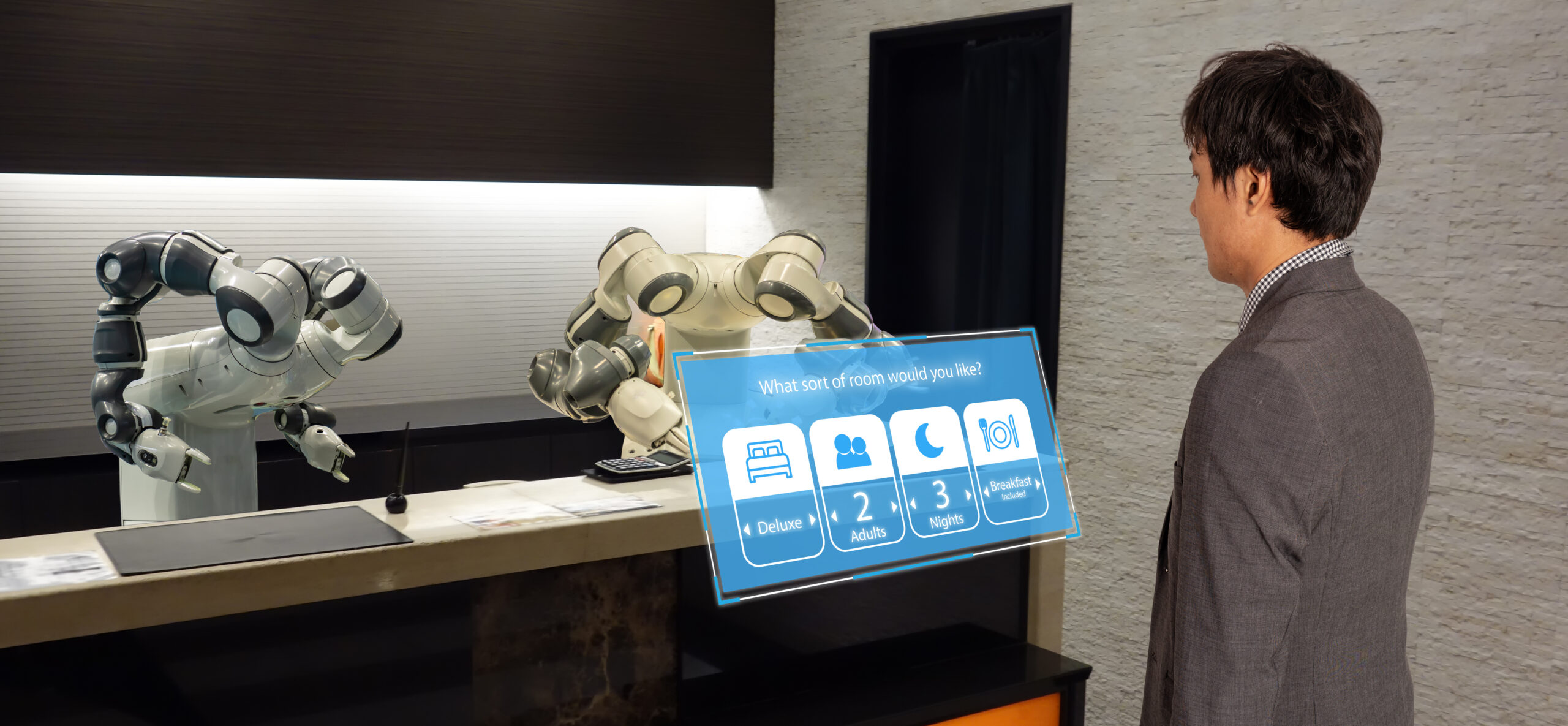
RPA rescue the hospitality industry ride the roller coaster of bookings; cancellations and amendments driven by the uncertainty of the current pandemic. The industry has seen that its time to change and that change will be permanent. The unprecedented impact from the COVID-19 Pandemic has thrown the hospitality industry into uncharted waters. There are so many unknowns and concerns for the immediate future. Hospitality businesses are expected to make considerable changes to their operations to safeguard employees’ and customers and re-engage with them to build their willingness to patronize their business. An unexpected by-product is that many businesses have taken the opportunity of site closures, restrictions to take a step back and take a long hard look at some fundamentals about their operations: What will the industry look like even in a post pandemic world? How can we prepare for the potential rollercoaster of impending rapidly imposed/relaxed lockdowns and restrictions? How do we interact and yet still delight our customers in the future? Digital is now a prevailing concept. The hospitality sector is looking to capitalize on such technologies to support customers choices as to whether they want to interact or distance themselves and how and how/when they to book. Industry leaders must look at tech-enabled solutions to increase operational efficiency and manage increasing volatility in operational processing of data. Suddenly when there is a lockdown, everyone cancel’s/amends their booking then lockdown eases everybody remakes their bookings. Some organizations now have 10s of thousands of emails sitting in inboxes waiting to be processed and are finding it difficult to ride the roller coaster. This is where RPA rescue the hospitality Industry is now turning increasing to a digital workforce. Robotic Process Automation (RPA) can automate time consuming processes and effectively drive greater efficiency. A robot can easily pick up the slack and process. Digital workers can work 24/7 and additional robots brought on-stream to cater for volatile demands. They fit right into the digital world. A key feature of RPA is that solutions can be delivered quickly and very cost effectively. This technology provides the adaptability and flexibility to integrate disparate systems and processes without the need of expensive source system developments and enhancements. Evolving a digital workforce can free up experienced staff to tackle evolving Covid-19 challenges.
BREXIT: RPA to the Rescue?

The one thing certain about the uncertainty of Brexit… …is that things will change. Businesses are being urged to consider all possibilities. But, many are unable to see the way forward. Only a fifth of small/med British businesses exposed to Brexit has prepared for the UK leaving without a deal…what to do? How about decluttering your business and building some internal capacity that can absorb the forthcoming changes, up to and after the end of October, even throughout any delay…and be able to react to whatever/whenever a turbulent post-Brexit deal/no-deal world looks like? Robotic Process Automation (RPA) empowered Digital Workers help to take away repetitive tasks that clog up your systems and processes. This gives you the space to use the expertise of your people to deal with whatever Brexit will throw at them. Think about it, for once you could be ahead of the game, and even if there’s no Brexit you have the dividend of such capacity to reinvest into your real business! A win-win. One thing is inevitable with Brexit, new regulations/processes and a whole new-fangled bureaucracy to deal with. Existing systems and process could struggle to cope; where processes, systems and interfaces could take a long time to modify. Inevitably there will be manual workarounds galore to bridge the gaps. Yet another set of Excel spreadsheets! With RPA, not only will you be getting productivity improvements here and now. But you are gaining valuable knowledge and experience of how your digital workers can rapidly react in the future. Experience shows us that RPA can be swiftly deployed in days/weeks, rather than months, to streamline and automate areas where systems interact. A digital worker can work across multiple systems seamlessly, without the need for cumbersome interfaces, which is invaluable if you have to move fast post Brexit. “To Brexit or Not to Brexit…That is the question… “. So maybe it’s time to acquaint yourself with RPA technology and understand what it can do…RPA and the associated deployment of digital workers may be the answer to free up capacity in your business… …but also remember, “digital workers are for life – and not just for Brexit!” localhost/centelli/
What Can Be Learned From The First Wave of RPA?

For many businesses, the initial implementation of RPA projects hasn’t been smooth sailing. In the technology’s early adoption, failures have been common. RPA uses software robots to take over repetitive and time-consuming tasks in organisations. This innovative and disruptive technology offers a multitude of benefits to organisations. These include cost-savings, to improved accuracy and increased customer satisfaction. However, with so much promise, why are there a multitude of RPA projects failing and what can be learned from these mistakes? In the recent 2019 Robotics and Automation Report by Raconteur in The Times supported by Centelli, the topic of learnings from the first wave of RPA is explored, particularly from the perspective of the industrial sector. The report highlights some of the reasons for RPA project failures and outlines some learnings for businesses moving forward: Most RPA failures are a result of human error rather than the technology itself In many of the early RPA projects, businesses note that the reason for failure has been down to human error. Either through a misunderstanding of the technology, inaccurate documentation of their own processes, poor implementation of the project, lack of expert support, insufficient maintenance after implementation or a host of other human errors. For RPA projects to be successful they cannot be viewed only as technology implementation projects delivered by IT. They are business projects with technology fuelling the desired outcome. The human element of these projects must be considered. Furthermore, businesses need to ensure they have the right support. From the very beginning of the project, right through to the ongoing collaboration with the digital workforce. A deep understanding of the processes that RPA will be taking over is key. In addition, so is ongoing maintenance of the digital workers. Read more about the learnings from the first wave of automation in the 2019 Robotics and Automation Report, supported by Centelli.