
5 AI Automation Trends to Know in 2026 if You’re a UAE Business

Want to explore five major AI automation trends surging today? With the UAE’s ongoing push to bolster its status as a global business hub, AI and automation are set to play a pivotal role. Adoption has gained steady traction in recent years—and it’s expected to accelerate as the government rolls out ambitious plans. A striking example is how the UAE Ministry of Finance revamped its internal processes using Robotic Process Automation (RPA), enhancing operational efficiency by 85%. Amazing, right? The environment also encourages AI exploration and practical applications across sectors. Notably, the UAE National Strategy for Artificial Intelligence 2031 states: “We will transform the UAE into a world leader in AI by investing in people and industries that are key to our success.” However, the evolution isn’t limited to the public sector alone. It’s actively reshaping businesses across industries as well. Furthermore, as use cases, tools, and solutions continue to advance, many exciting new concepts are emerging. Top Automation AI Trends to Know in 2026 In a market like the UAE — driven by ambition and innovation — staying ahead of the curve is crucial! So, whether you’re a business, an organization, a leader, or part of the workforce, the following AI automation trends are worth noting. And they’re making waves worldwide! Let’s dive in! 1. AI-Enhanced RPA No doubt, the traditional RPA is great for repetitive, rule-based tasks involving structured data. But when you marry RPA with AI tech like Machine Learning (ML), Natural Language Processing (NLP), or Computer Vision — that’s when things get next-level! Key Features: Value Delivered: Reduces manual intervention, increases processing speed and accuracy, optimizes workflows, and frees up teams to pursue high-value tasks. 2. Intelligent Automation Intelligent Automation (IA) merges RPA, AI, Business Process Management (BPM), and other technologies to automate more complex, cross-functional business workflows. Often referred to as Cognitive Automation or Digital Process Automation, it also includes applications like Generative AI. Key Features: Value Delivered: Supercharges digital transformation, uplifts operational precision, boosts organizational agility, and fosters continuous innovation. 3. Digital Workers These are AI-powered software bots designed to operate like virtual team members, capable of managing both routine and complex tasks. Key Features: Value Delivered: Improves productivity, minimizes human errors, accelerates turnaround times, and enables staff to focus on strategic priorities. 4. Hyperautomation In simple words, it’s a comprehensive, accelerated approach to automating as many business and IT processes as possible within an organization. Key Features: Value Delivered: Expedites digital transformation, supports data-driven decision-making, and builds greater operational resilience. 5. Agentic AI An advanced class of AI systems built around autonomous agents capable of perceiving, reasoning, and acting independently to achieve specific objectives. Key Features: Value Delivered: Automates knowledge-based, multi-step processes, elevates problem-solving capabilities, and unlocks new opportunities for intelligent automation. If You’re a UAE Business Looking to Leverage AI / Automation Whether you seek operational efficiency, real-time decisions, an empowered workforce, or streamlined costs, please understand: AI and automation aren’t a cookie-cutter solution. Every organization should approach them based on its own complexity, resources, and goals. Nevertheless, we’re seeing a growing number of use cases across industries. Retail, Real Estate, Tourism & Hospitality, Construction, Manufacturing, Transportation & Logistics, Healthcare, Financial Services, Telecom, Energy & Power, or Government – you name it! The same goes for departments and functions. Customer Service, Finance & Accounts, Back-Office, Inventory & Supply, Project Management, Human Resources, R&D, Product Development, Training & Development — AI/Automation is making its way everywhere. As trusted solutions partners of UiPath (Automation & Agentic) and Soroco (AI), we at Centelli provide custom-built, ROI-driven implementations that deliver real results. Book a no-strings-attached call today to discover how we can help your business. And now a few things to keep in mind: Here’re the key themes driving the present phase of business tech innovation via automation / AI.
How Digital Workers Are Powering Clermont’s Hotel Booking Automation
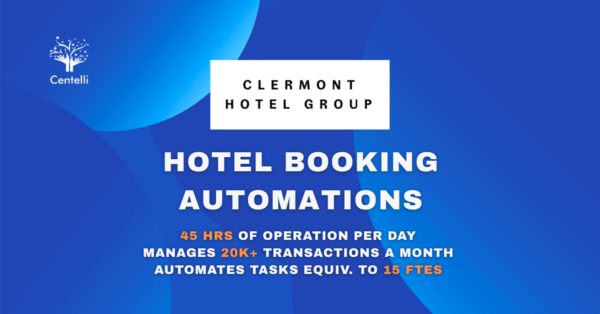
Hotel Booking Automation can be a game-changer for a hospitality business! Bookings and customer experience are core pillars of success in this industry. Guests must keep coming — and leave satisfied. And it all starts with the hotel booking system itself, because a seamless reservation is the first positive impression a guest takes in! However, Clermont Hotel Group was facing dual challenges: fluctuating demand and staffing issues. The pandemic brought unprecedented disruptions too, forcing a rethink. So, they decided to step up and found the perfect solution in automated bookings, powered by a Digital Worker. (It’s a special kind of software built to autonomously tackle repetitive, complex, or high-volume tasks!) Reimagining Clermont’s Hotel Booking System with Digital Workers The hospitality industry is known for its dynamic environment. Hotel companies constantly need to balance personal guest interactions with operational efficiency. Clermont Hotel Group, based in the UK, operates 16 hotels with over 4,000 rooms, more than 100 event spaces, and several bars and restaurants. Now, imagine the scale of operations and the sheer volume of booking inquiries they manage each day. Aiming to streamline their reservation system, the brand reached out to Centelli — and so began their ‘Digital Worker’ journey, which has been remarkably successful. Our team of Intelligent Automation experts designed, developed, and deployed a Digital Worker named Bertie. Key tasks Bertie performs include: The advantages of reduced manual processing, improved accuracy, and heightened staff and customer satisfaction are evident. Keep reading for more insights! 3 Key Benefits of Hotel Booking Automation with Digital Workers Bertie, the Digital Worker, has proven to be an indispensable asset for Clermont, delivering clear and tangible advantages. Here are the top three benefits: 1. Enhanced Data Handling Bertie extracts and verifies all relevant booking information from emails: This minimizes human error and ensures confirmation numbers and payment details are always correct. “Having a Digital Worker as part of the team is fantastic! It takes on the more monotonous tasks, more accurately and efficiently — leaving the rest of the staff to deal with bespoke requests.” Melanie Cole, Head of RSC, Clermont Hotel Group 2. Improved Operational Efficiency The Digital Worker delivers serious efficiency gains in bookings management: This has not only improved efficiency across the guest administration process but also eased our client’s recruitment challenges and helped cut back operational costs. 3. Streamlined Staff Workload and Experience Automation hasn’t just saved time on routine bookings and front desk tasks. With reduced workloads, Clermont’s staff now have more time to engage directly with guests, helping them to: Notably, this also enhances the employee experience and contributes to better staff retention. Setting Up Hospitality Digital Workers and the Cost Factor At Centelli, our Digital Worker solutions are custom-built — and for good reason. Every hotel operation is different, so we tailor these solutions to your exact needs, goals, and operational challenges. In most cases, the Digital Workers integrate seamlessly with your existing systems. While some adjustments may be needed occasionally, we typically work with what you already have. They can also be deployed alongside existing automations to enhance your system’s capabilities and drive even greater efficiency. “We already had some automation within our booking processes, but with so many partners and integrations, there was still a lot of manual data transfer. Centelli worked with us to understand that a Digital Worker could perfectly complement our existing processes.” Chris Ball, Business Development Director, Clermont Hotel Group A New Era of Hotel Booking Automation & Hospitality Innovation The impact Digital Workers have delivered for Clermont Hotel Group is a practical use case of how the right technology can transform your operations. And their value doesn’t stop at bookings! You can also use them for: These are some common examples, but Digital Worker automation is mouldable to many more functions and processes across hospitality. Significantly, with AI integrations advancing, these solutions are set to further reimagine this high-stakes industry. If you’re looking to automate your hotel booking system process or other hospitality operations, feel free to reach out and book a quick, no-obligation meeting today!
High-Performing Finance Teams: Unlocking Efficiency and Impact with Intelligent Automation
High-performing finance teams are the cornerstone of business success. However, even the most effective teams must evolve to continue their dream run. Systems become obsolete, processes grow stale, and inefficiencies creep in—and there’s no escaping the shifts brought by modernization and digitalization. So, you may need to reimagine your operations, enhance processes, improve workflows, and adopt better tools to keep achieving great results. Intelligent Automation (IA) can be a significant force multiplier for finance departments across roles. Think of IA as an ally, enabler, and amplifier—helping your team stay at the top of its game! High-performing finance teams are efficient, accurate, and fast-moving. They excel with strong analytical skills, the ability to use data effectively, and close collaboration. Intelligent automation can significantly enhance these capabilities, providing the tools and resources to become even more effective. Download our free guide “AI and Automation in Finance Teams,” featuring key insights and our real-world case studies. 5 Big Performance Blockers for Finance Teams There are two possible scenarios: If you are striving for a high-performing finance team, it’s important to identify and overcome the challenges and barriers that are stopping you. The most common performance blockers for finance teams include: You commonly see accountants working endless hours on data entry, updating, reconciling, or preparing reports. As boring and uninspiring as it is, errors and oversights are quite likely. These low-value yet time-intensive activities distract your team from more strategic tasks. Growing data volume is already a significant challenge, but navigating multiple data sources (e.g., CRM, ERP, PPM) can truly overwhelm your finance team, especially with archaic data management tools requiring manual processes. This makes tracking, reporting, and ensuring compliance a constant struggle. Slow processing, reworks, heavy workloads, and resource crunches can derail schedules and deadlines. Sudden assignments only add to the pressure. Not just routine tasks like monthly reporting and payroll—critical tasks like sales tax filings and audits can also drag on, increasing compliance risk. The Intelligent Automation revolution is here. This third wave of digitization and generative AI enables businesses to integrate unstructured content with analytical AI’s structured data capabilities. We can see massive productivity gains, particularly in finance operations, a report apprises. Financial information comes in diverse formats, and traditional systems may not be equipped to handle unstructured data like text documents, emails, images, and videos. Inconsistencies prevent an accurate, holistic view—a common issue with data silos and manual processing. Communication gaps among finance team members and with other departments can be a recipe for delays, errors, and poor decisions. Without collaborative workflows and real-time data, your team faces gaps, confusion, and outdated information. Tasks take longer, and overall efficiency declines. Intelligent Automation: Key to High-Performing Finance Teams Finance and accounting teams at every level can thrive with intelligent automation. Automated processes and AI tools help employees work quickly and accurately. Key Highlights: Wondering how it may pan out for different roles? 1. Finance Analysts/Accountants: Do More, Do Better—and Faster How? Freedom from mundane work. More exposure to value-add, strategic tasks enables upskilling and learning. Key Use Cases: Data Entry, Document Processing, Transaction Processing, Reconciliations, Report Generation, etc AI and Automation were the top CFO Priorities in 2024. We provide customized AI solutions crafted using the right tools and technologies to meet your exact operational needs. If you’re looking for Intelligent Automation solutions that deliver real impact and value, speak to us. Schedule your call here. 2. Finance Managers/Supervisors – Uplift Team Efficiency and Performance How? Empowers mid-tier managers to lead teams more effectively. Facilitates process innovations, helping them step into more strategic roles. Key Use Cases: Document Processing, Workflow Automation, Dashboards, Reports & Analytics, Process Mining, etc. 3. CFOs and Controllers – Boost Strategic Decision-Making & Outcomes How? Helps finance leaders position finance team as a strategic asset. And drive financial excellence and digital transformation, and business growth. Key Use Cases: Customized Reports, Data Visualization & BI, Predictive Analytics, Financial Risk Assessment, etc. Real success stories from our clients: Case Study: Our Automated Invoice Reconciliation solution has improved financial visibility for this automotive dealership group, improving decision-making. Case Study: This Atlanta-based healthcare provider leverages our Digital Worker for billing, records, and finance. It enhanced accuracy and efficiency while staying HIPAA compliant! Ready to transform your finance team with Intelligent Automation? Book Your Meeting Now! Key Takeaways Intelligent Automation is becoming a critical success driver for high-performing finance teams.
Transforming Airline Business Travel with AI
The last few years have seen a lot of uncertainty in the Travel and Hospitality sector. Managing corporate bookings, tracking reservations, and ensuring seamless travel experiences require significant effort—until now. Thanks to AI-driven automation, businesses can streamline these processes, reducing manual work and improving accuracy. One of the most exciting advancements in this space is using AI, like GPT, to read and extract structured data from free-text emails. How AI Transforms Business Travel Management Traditionally, processing business travel requests involved manually sifting through emails, identifying key details, and matching them with internal systems. This time-consuming process was prone to errors and inconsistencies. With AI-powered solutions, businesses can automate these tasks with greater precision and efficiency. Automated Data Extraction from Emails AI can be trained to process free-text emails by providing a clear prompt describing the required output. For airline business travel, this includes: This automated extraction allows businesses to seamlessly integrate the correct information into their systems, eliminating the need for manual lookup and reducing processing time. According to recent industry data, 75% of businesses in the travel sector implementing AI-driven automation reported a 40% increase in operational efficiency and a 30% reduction in manual processing errors. Enhanced Accuracy with Web Integration One of the most powerful aspects of AI-driven automation is the integration of web search capabilities. The hotel names and room types provided in booking emails often do not perfectly match a company’s internal naming conventions. With AI, the system can cross-reference these details against the company’s website to retrieve the exact internal hotel and room name. This ensures that the correct information is used for the next stage of the booking process, which may still require human intervention. In the airline and hospitality sectors, businesses using AI-powered search integrations have reduced data retrieval time by up to 60%, allowing for faster decision-making and improved service delivery. Opening New Possibilities for Data Search & Extraction The ability to leverage AI for structured data extraction extends beyond business travel management. With web-integrated AI, companies can: Through interviews with clients and industry professionals, we’ve found that hotels and travel companies that adopt AI-based data management save an average of $500,000 per year due to reduced administrative workloads and improved efficiency. Expanding AI’s Role in Hospitality and Travel AI solutions for hospitality and travel management are evolving rapidly. For an in-depth look at how AI transforms booking request management in the hospitality sector, check out this insightful article: AI Solutions for Hospitality Booking Request Management. This resource highlights how AI-powered automation reshapes how hotels handle reservations, improve customer experiences, and optimise operations. The Future of AI in Corporate Travel and Hospitality Integrating AI in airline business travel management marks the beginning of a new era. As AI capabilities evolve, we can expect even more sophisticated automation, including real-time adjustments based on traveller preferences, automated itinerary management, and predictive analytics for optimising corporate travel expenses. With 85% of travel executives planning to increase AI investments in the next five years, AI’s impact on the airline industry will only grow, making it a crucial tool for staying competitive. For businesses looking to stay ahead, investing in AI-powered data extraction and automation solutions is no longer optional—it’s essential. The world of business travel is transforming, and AI is at the heart of this revolution. Are you ready to leverage AI for seamless travel management? Book your first meeting here! Download Your free guide to automation in hospitality HERE.
AI Solutions for Hospitality Booking Request Management
Personalised service is the key to creating exceptional guest experiences. Managing and analysing customer booking requests efficiently has become crucial for hotels and service providers aiming to stay ahead in a competitive market. Cutting-edge Automated Intelligence (AI solutions) is at the heart of this transformation. These are designed to extract critical information seamlessly and accurately. Introducing an Advanced AI Solution for Booking Requests Our AI-driven model is a game-changer, engineered to effortlessly extract vital details from customer booking requests. By utilising advanced natural language processing (NLP) techniques, this AI solution is capable of identifying and categorising complex booking information, including: This AI solution simplifies operations, reduces manual errors, and enhances guest satisfaction by ensuring that no detail is overlooked. Behind the Scenes: How AI Solutions Work The AI-powered system integrates an end-to-end pipeline leveraging state-of-the-art NLP techniques, including: We employed an ensemble approach to achieve unparalleled accuracy, aggregating outputs from multiple independently trained models. This technique ensures that the final insights are robust and reliable, even when dealing with diverse and complex customer inputs. These AI solutions set a new benchmark for booking management efficiency. Real-World AI Solution Applications in Hospitality Our AI solutions have been successfully deployed with industry-leading clients such as Clermont Hotel Group and Dalata, demonstrating their effectiveness in real-world scenarios. By automating the extraction and categorisation of booking details, these clients have streamlined their operations, reduced processing times, and elevated the guest experience. This innovative AI solution aligns with the growing trend of hospitality industry automation, enabling hotels to enhance operational efficiency while delivering personalised guest experiences. Businesses can focus on strategic decision-making rather than administrative tasks by utilising AI booking pipelines and text summarisation in hospitality. The Future of Hospitality Technology As AI continues to evolve, its applications in the hospitality sector are set to expand. The potential is limitless, from automating routine tasks to delivering hyper-personalised experiences. Integrating smart hotel booking systems, AI solutions, and machine learning in hospitality is poised to revolutionise how hotels interact with their guests. Our AI-powered solution for booking requests is just the beginning of a broader movement towards smarter, more efficient hospitality operations. Conclusion By integrating AI solutions into the booking process, hotels and service providers can transform how they manage guest requests, ensuring accuracy, efficiency, and superior customer service. With proven results and cutting-edge technology, our AI solutions empower businesses to stay competitive and exceed guest expectations. Ready to elevate your hospitality operations with AI solutions? Contact us today to learn how our AI solutions can revolutionise your booking management process!
Email Analysis and Labelling Tools: Elevate Your Productivity!
With advancements in technology, email analysis and labelling tools now offer transformative ways to extract meaningful insights, streamline workflows, and improve decision-making processes. But what does email analysis and labelling entail, and how can it revolutionise your approach to communication? What is Email Analysing and Labelling? At its core, email analysis and labelling involves extracting, categorising, and interpreting information from emails. This process is powered by advanced technologies such as natural language processing (NLP) and machine learning, allowing businesses to: Expanding Beyond Emails While email analysis remains a cornerstone, these techniques can be applied to other text sources, such as IT ticketing systems (e.g., Salesforce and Freshservice) and communication platforms. Organisations can unlock insights that drive better decision-making by analysing structured and unstructured data across platforms. Key Features of Email Analysis and Labelling Tools 1. Email Semantics and Labelling Understanding the semantics of an email involves interpreting its meaning and context. Automated labelling tools classify emails based on predefined rules or learned patterns. For instance, an email containing “invoice” may automatically be tagged under “Finance.” 2. Field Extraction (Entity Recognition) Entity extraction, or field recognition, identifies key pieces of information within an email, such as names, dates, amounts, or issues. UiPath, for example, uses the term “fields” instead of “entities,” emphasising a more intuitive approach to recognising and organising information. 3. Sentiment Analysis Email sentiment analysis evaluates the tone of an email. This feature is particularly useful for customer service and sales teams, as it provides insights into client or stakeholder satisfaction levels. For instance, a negative tone might indicate a frustrated customer requiring immediate attention. Applications of Email Analysis and Labelling Tools Across Platforms Outlook Inboxes By integrating email analysing tools with Outlook, users can: Salesforce and Freshservice For businesses leveraging IT ticketing systems like Salesforce or Freshservice, email analysis can: Benefits of Email Analysis and Labelling Tools Embrace the Future of Email Analysis and Labelling Tools Email analysis and labelling tools are no longer optional – they’re essential for staying competitive in a data-driven world. Whether you’re managing a cluttered inbox or optimising IT ticketing workflows, leveraging these tools can transform how you work, communicate, and grow. Ready to take the leap? Explore the latest solutions in email analysis and labelling tools and see how they can redefine productivity for your business today.
How Automation and AI Reduce Business Risks

Digital Workers are designed to perform repetitive tasks over and over again in exactly the same way, which in turn reduces the likelihood of mistakes.
Overcoming Automation Implementation Challenges: A Guide
Automation is a game-changer for businesses, offering enhanced efficiency, reduced costs, and improved accuracy. However, the path to successful automation is not without its challenges. This blog explores the key obstacles and provides practical strategies for overcoming automation implementation challenges, focusing on infrastructure requirements, ownership within the business, and identifying the best processes. Infrastructure Requirements for Automation Implementing automation requires a solid infrastructure to support the technology. Here are a few essential requirements: Robust IT Infrastructure Security and Compliance Reliable Network Connectivity Ownership Within the Business Assigning clear ownership of automation initiatives is critical for successful implementation. Here’s how to ensure effective ownership: Cross-Functional Teams Leadership Support Training and Education Finding the Best Processes to Start With Identifying the right processes to automate is crucial for achieving quick wins and demonstrating the value of automation. Here’s how to select the best processes: High Volume, Repetitive Tasks Rule-Based Processes Time-Consuming Tasks High Impact on Business Goals Overcoming Common Challenges Resistance to Change Technical Challenges Cost Concerns Conclusion Implementing automation presents several challenges, but these can be effectively managed with the right approach. Businesses can successfully navigate the automation journey by ensuring a robust infrastructure, establishing clear ownership, and carefully selecting the best processes to start with. Embrace these strategies to overcome obstacles and unlock the full potential of automation, driving efficiency, cost savings, and growth in your organisation.
Five ways to measure ROI in Intelligent Automation: A Guide

The Return on Investment of Intelligent Automation: A Comprehensive Guide Organisations increasingly turn to intelligent automation (IA) to streamline operations, enhance productivity, and drive growth. But what exactly is the return on investment (ROI) of implementing intelligent automation, and how can it be effectively measured? This blog delves into the multifaceted benefits of IA and provides a detailed overview of how to quantify its ROI. Understanding Intelligent Automation Intelligent automation integrates artificial intelligence (AI) with robotic process automation (RPA) to automate complex business processes. Unlike traditional automation, which follows pre-programmed rules, IA can adapt and learn from data, making it capable of handling more sophisticated tasks. Benefits of Intelligent Automation 1) Cost Savings 2) Improved Productivity 3) Enhanced Accuracy and Compliance 4) Scalability and Flexibility 5) Customer Satisfaction Measuring the ROI of Intelligent Automation Organisations should consider quantitative and qualitative metrics to measure intelligent automation’s ROI effectively. Here are some essential methods: 1) Cost-Benefit Analysis 2) Productivity Metrics 3) Quality and Compliance Metrics 4) Employee and Customer Satisfaction 5) Scalability and Flexibility Conclusion Intelligent automation offers a compelling ROI by driving cost savings, improving productivity, enhancing accuracy and compliance, and boosting customer satisfaction. By carefully measuring and analysing these benefits through various metrics, organisations can make informed decisions about their automation investments and realise significant long-term gains. As IA continues to evolve, its potential to transform business operations and deliver substantial ROI will grow, making it a crucial element of modern business strategy.
Automation In Real Estate: How Digital Workers and AI Boost Efficiency & Profits
In our own work with AI, we have seen real estate companies gain over 10% or more in net operating income So states McKinsey, highlighting the transformative potential of automation in real estate sector. As the industry embraces generative AI (gen AI) and intelligent automation, Centelli is at the forefront, offering innovative solutions that streamline agent management and enhance operational efficiency. Here’s how Digital Workers and AI boost efficiency and profitability for realtors: Automation Digital Workers for Real Estate Agent Management Managing agent onboarding and offboarding is a significant challenge in the real estate sector. Centelli’s Digital Workers address this issue by providing precise and efficient solutions: Fail-Safe Checks for Real Estate Agent Directories Reliability is a cornerstone of Centelli’s automation solutions. Our Digital Workers conduct monthly audits, cross-referencing state directories with your internal records to ensure accuracy. If discrepancies arise, they alert a human supervisor for intervention, guaranteeing compliance and preventing errors. Leverage Gen AI for Property Listings McKinsey’s insights into generative AI underscore its transformative potential for the real estate sector. Companies can leverage gen AI to draw from vast databases, providing rapid responses and enhancing task efficiency. AI-powered chatbots, for instance, can access property listings and offer quick information, improving customer service and boosting productivity. For more detailed insights, visit McKinsey’s article on generative AI in real estate. Improve Real Estate NOI with Automation & AI Centelli’s work with AI has shown that real estate companies can achieve significant gains in net operating income (NOI). Businesses can increase revenue and operational efficiency by automating administrative tasks and leveraging AI to uncover new commercial opportunities. Download our FREE GUIDE focused on automation in the real estate sector. Enahnce Real Estate Customer Service with AI AI also enhances the customer experience and boosts tenant retention by creating more efficient operating models. For instance, gen AI tools can analyze lease documents, summarizing key information and helping property owners manage their properties more effectively. McKinsey outlines seven actions real estate leaders can take to fully benefit from gen AI, emphasizing the importance of addressing implementation and scaling challenges. The Centelli Advantage Centelli’s Digital Workers exemplify the potential of intelligent automation in the real estate sector. By handling the complexities of agent management and integrating with essential systems, they free up valuable time and resources. This allows real estate professionals to focus on core business activities, driving productivity and growth. We offer customized, sector-specific Intelligent Automation, Digital Worker, and RPA solutions for businesses of all types, actively serving the UK, Europe, US, India, and Dubai, UAE. Book Your Free Consultation here! In conclusion, the future of real estate is bright with the integration of gen AI and automation. Centelli’s tailored solutions provide the efficiency, accuracy, and reliability needed to thrive in this evolving landscape. Embrace the power of Digital Workers and unlock new levels of operational excellence in your real estate business. Want to learn more about Digital Workers or have questions about our Intelligent Automation solutions? Drop us a line here!