
What Can Be Learned From The First Wave of RPA?

For many businesses, the initial implementation of RPA projects hasn’t been smooth sailing. In the technology’s early adoption, failures have been common. RPA uses software robots to take over repetitive and time-consuming tasks in organisations. This innovative and disruptive technology offers a multitude of benefits to organisations. These include cost-savings, to improved accuracy and increased customer satisfaction. However, with so much promise, why are there a multitude of RPA projects failing and what can be learned from these mistakes? In the recent 2019 Robotics and Automation Report by Raconteur in The Times supported by Centelli, the topic of learnings from the first wave of RPA is explored, particularly from the perspective of the industrial sector. The report highlights some of the reasons for RPA project failures and outlines some learnings for businesses moving forward: Most RPA failures are a result of human error rather than the technology itself In many of the early RPA projects, businesses note that the reason for failure has been down to human error. Either through a misunderstanding of the technology, inaccurate documentation of their own processes, poor implementation of the project, lack of expert support, insufficient maintenance after implementation or a host of other human errors. For RPA projects to be successful they cannot be viewed only as technology implementation projects delivered by IT. They are business projects with technology fuelling the desired outcome. The human element of these projects must be considered. Furthermore, businesses need to ensure they have the right support. From the very beginning of the project, right through to the ongoing collaboration with the digital workforce. A deep understanding of the processes that RPA will be taking over is key. In addition, so is ongoing maintenance of the digital workers. Read more about the learnings from the first wave of automation in the 2019 Robotics and Automation Report, supported by Centelli.
Frequently Asked Questions: Robotic Process Automation (RPA)

If you’re considering Robotic Process Automation (RPA), also known as a digital workforce, for your organisation, you might have a few questions that need answering before you go ahead with the investment. Here are some of our most frequently asked questions about our RPA solutions. If you’re still unsure or have questions, please get in touch to speak to one of our experts. Q: What can a digital worker do? A: A digital worker (also known as a bot) can do most of the routine tasks that are carried out by human workers. They access applications by taking over the keyboard and mouse of a computer, similar to the way a human would interact with them. Of course, a digital worker’s cognitive capabilities are lower than a human worker’s and they are therefore better suited to routine, repetitive and rule-based processes. Q: What are the various cost components to consider when deploying a digital worker? A: There are three components to consider when deploying a digital worker: UiPath, the software platform’s license costs; Infrastructure to run the software: this cost is similar to the cost of giving a human worker a laptop; Training cost (in other words how much it costs to configure the software): this depends on complexity but is comparable to training a human worker on the very same business process. In our experience, costs for deploying a digital worker can be recovered within a few months, while benefits like improved customer service and higher accuracy are available immediately. Q: Do RPA projects typically take long to implement? A: With UiPath, RPA projects can be deployed in as little as a few days and up to a few weeks. The best approach is to begin by enabling smaller processes or tasks and then growing from there. Q: How do we monitor and manage digital workers? A: Management of digital workers is best done through the digital team lead, called the UiPath Orchestrator. Orchestrator has a user-friendly interface which is used to monitor and manage the digital workforce. It has the functionality to schedule tasks, manage configuration, maintain queues, allocate tasks to the digital workers, and so on… basically, everything you would expect a human manager to do. Q: Are my processes suitable for RPA? A: Most routine, repetitive processes are suitable for RPA. Evaluate if a process is suitable or not by considering the following: Can the process, especially the exceptions, be documented? How many times a day, week or month does the process run? What effort is needed each time the process runs? What are the benefits of automation: for example, improved accuracy, reliability, response times, better scalability, productivity? Q: Is much ongoing support needed for my digital workforce? A: In most cases, ongoing support is negligible. Digital workers are trained to provide feedback on their work via email or logs. On occasions when an application is unreliable: for example when response times vary or there are inconsistencies in the business processes, human intervention might be needed. In these cases, intervention can be managed by a support team or an individual’s input can be planned into the digital workers’ processes. Q: What is the difference between AI and RPA? A: AI and RPA are complementary. AI is a broader field that deals with how computers interpret and analyse data. It is more analogous to how the human brain thinks. RPA, on the other hand, is automating processes as a sequence of tasks or defined steps similar to spreadsheet macros. For some tasks, such as extracting data from an invoice or scanned document, a digital worker needs capabilities similar to that of a human. At this point, AI would step in to provide the cognitive capabilities needed and would need to be trained over a number of iterations. On the flip side, an AI algorithm needs to fit into a business process to be of value. RPA can provide the surrounding infrastructure such as sourcing data and taking action on the output of the AI algorithm. Q: What training do my staff need to collaborate with digital workers? A: The simple answer is No; staff collaborate with digital workers in the same way they collaborate with a human team or team member. Digital workers provide their process updates for example through email or an updated file and receive instructions through the digital team lead a user-friendly web application called UiPath Orchestrator. Q: How will digital workers complement my human workers? A: Digital workers will enhance human workers lives by automating routine and repetitive tasks freeing them to focus on more cognitive tasks and in providing greater direct customer experience. Eventually, when all computing applications seamlessly talk to each other, all routine tasks will be automated. In the meantime, there are gaps between applications which need to be filled by humans. Digital workers are typically taking over tasks that humans don’t want to or shouldn’t be doing. Q: Does the deployment of digital workers require changes to computing applications? A: No, it doesn’t. One of the biggest benefits of digital workers is that they are non-intrusive and don’t need any application changes. They are very good at linking standalone systems without the need for expensive interfaces. Digital workers interact with applications just like a human would – by providing keyboard and mouse input and reading the screen. This makes digital workers as versatile as humans and quick to deploy. Q: Are digital workers scalable? A: Scaling a digital workforce, either for a single robot or hundreds, takes only a few hours to do. Buy a license, allocate infrastructure, create application access and add to UiPath Orchestrator to enable it to start allocating tasks. Some of the activities such as infrastructure and application access are similar to recruiting a human worker. Beyond that, it is much faster! Still have questions? Please don’t hesitate to get in touch to speak to one of our experts.
The Rise of RPA & Its Impact on The Workforce

Will RPA have an impact on your workforce and reshape the labour market in years to come? Robotic Process Automation (RPA) is growing rapidly. As more and more organisations are adopting this crucial tool along their digital transformation journey, seeking the unprecedented benefits of elevated productivity and value that automation provides. It is becoming increasingly important for leaders to understand the impact this will have on their workforce and the labour market. RPA is growing rapidly While the RPA industry is still in its early stages, this innovative technology is being widely implemented across a number of businesses in various industries. The 2019 Robotics and Automation Report recently published by Raconteur in The Times (supported by Centelli) notes that RPA has grown by 63% in 2018 and is expected to grow a further 54% in 2019 – making it the fastest-growing enterprise-software category. Download: Robotics and Automation Report Benefits of RPA on the workforce With the rapid adoption of this transformative technology, organisations and leaders need to consider how this will impact their workforces and the labour market. Therefore, the implementation of RPA can bring invaluable benefits to an organisation from a workforce perspective, including: Increased productivity as repetitive processes are handed over to digital workers More time for employees to perform value-adding tasks that improve quality and service Heightened employee engagement as teams are released from mundane activity How RPA is changing the labor market However, with these benefits comes an element of change that you can manage effectively. The rise of automation and RPA is expected to change the current split in type of work carried out by the workforce. Experts agree that the change will bring about a major increase in the need for social/emotional and technological skills. Trending skills for a human-robot collaborative workforce In a survey of business leaders, results show that the key skills that will be in demand in 2022 for a workforce that embraces human-robot collaboration will be: Analytical thinking and innovation Active learning and learning strategies Creativity, originality and initiative Technology design and programming Critical thinking and analysis Complex problem solving Leadership and social influence Emotional intelligence Reasoning, problem-solving and ideation Systems analysis and evaluation Embracing the future of a digital workforce Rather than fearing the inevitable change that will continue to come from the rise of RPA, we encourage organisations to view transformation and automation as a major opportunity that will benefit both organisations and employees alike. Robotics and automation are not here to take away human roles or make your current staff redundant. Instead, RPA is an effective solution for creating additional capacity within your teams to carry out more value-adding tasks. These will benefit your business quality of work and customer service. In addition, it will also create more engaging and fulfilling roles for your employees. Centelli RPA RPA is about more than just technology; it is about empowering workforces and organisations. At Centelli, we too are about more than just technology. With strong expertise in process optimisation and business operations, our team offer a service that goes far beyond simply providing a technological solution. We help organisations foster an environment suitable for effective human-robot collaboration and help businesses to make the most of a digital workforce. Get in touch to speak to one of our experts.
Robotics and Automation Report 2019
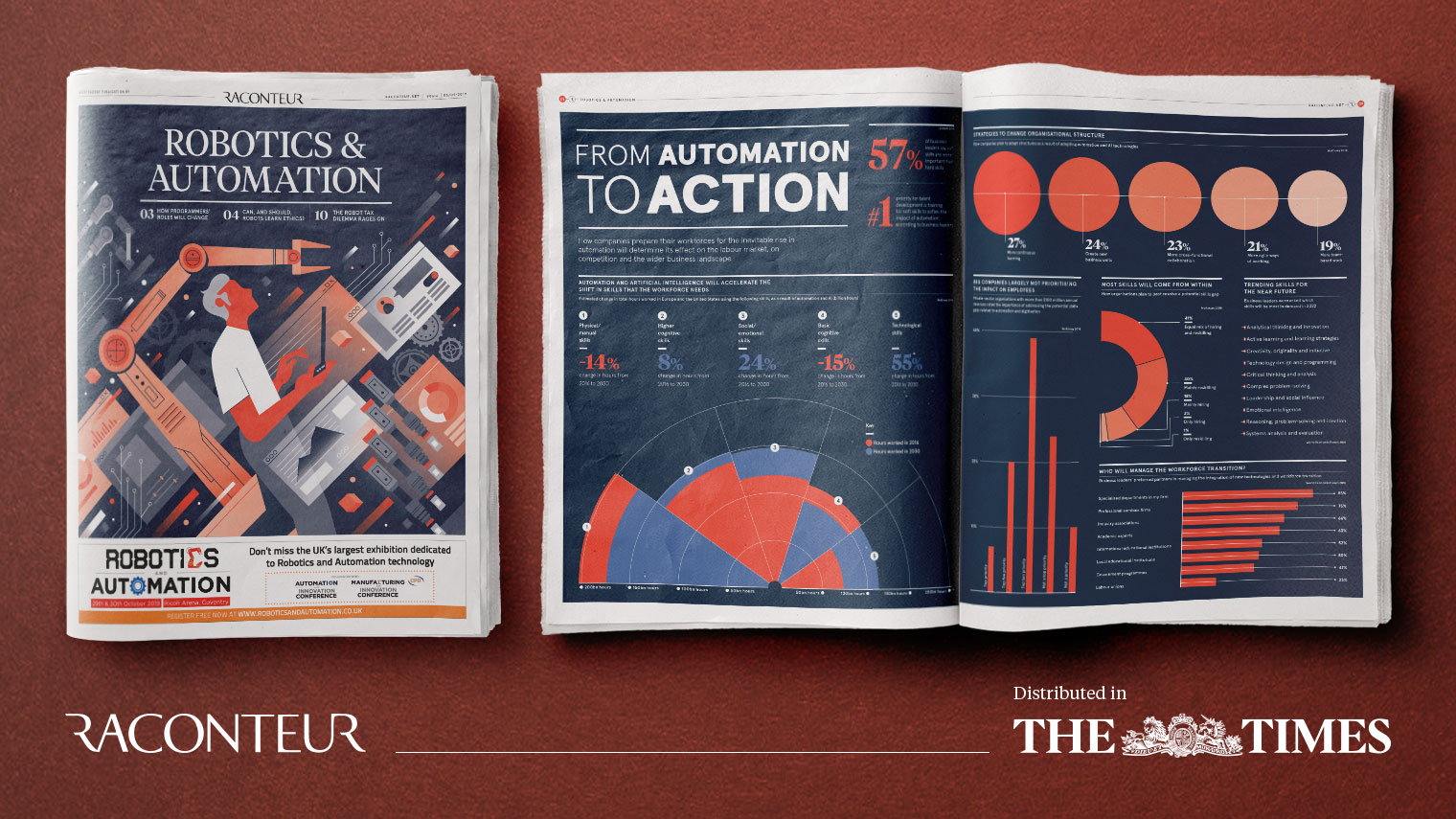
Centelli have been proud to support the latest Raconteur report in The Times which delves into the world of Robotics and Automation and how it is changing the way we work. In 2019’s digital era, automation is something that businesses and leaders cannot ignore. This report looks at what changes need to be made in our current systems to adapt to a new world where robots are increasingly being integrated into society. Download the report to read about how companies can prepare their workforces for the inevitable rise in Robotics and automation, how to improve organisations efficiency using robotic process automation and what mistakes to avoid when pursuing human-robot collaboration within your workforce. Download the full report here.
A Digital Worker Could Boost Your Company’s Productivity Overnight

Increasing productivity remains essential for any business aiming to expand and amplify its profits, a perspective corroborated by the Harvard Business Review [1]. The challenge of producing increased output with the same workforce size, intriguing management for centuries, is being transformed through the deployment of digital workers. As highlighted by Hayes and Abernathy [1], productivity improvements lead to higher revenue and GDP, becoming a focal point for governments globally. Consequently, boosting productivity has broad societal benefits, as it stimulates economic health, and what’s good for the economy benefits everyone. To this day, the simple solution to increasing productivity is always found in the same place – advances in technology. For years both machines and computers have been integral to the good health of a company’s bottom line. As a matter of fact, a comprehensive study in the Journal of Business Research confirmed that the strategic use of Information and Communication Technology (ICT) leads to a significant improvement in a company’s performance [2]. The Rise Of Machines Technology has and continues to reshape the modern workplace. In turn, this has led to a surge in productivity and growth. For example, think of how the steam engine transformed the heavy industry. In the hands of one capable individual, a steam engine could carry out the same workload which hundreds of employees were once paid to do. In such a scenario, the surge in productivity and reduction in costs speaks for itself. Likewise, consider a world where emails didn’t exist. Written communication could only be conducted via physical paper, i.e. snail-mail. Communication speeds would suffer dramatically, wasting resources. Increased productivity through technology is all about improving communication, reducing waste, and enabling more efficient work practices. The ultimate end goal of this is the digital transformation of the workplace which will lead to a digital workforce capable of boosting productivity like never before. The Dawn of the Digital Worker The intent of a digital worker is not to replace human employees. RPA (Robotic Process Automation as the industry called it – Routine Processes Annihilated as well call it) is intended to liberate employees to concentrate on the tasks that add value, innovate and deliver great customer experience. Using non-invasive technology, i.e. it works with existing computing systems without a need for any change in them, a digital worker replicates the way a human carries out repetitious work tasks on a computer. The Need for Speed With RPA, a digital workforce can complete predefined tasks up to ten times faster than its human counterparts. A digital worker will also make zero errors. Advances in artificial intelligence (AI) technology are fostering the creation of a digital workforce that can perform complex tasks, learn new things, and make independent decisions. This is in line with the Brookings Institution’s research, which indicates that AI is fundamentally transforming the world by enabling machines to exhibit such advanced capabilities to enhance and support the work of their human counterparts [3]. Working Around the Clock Money never sleeps and neither does a digital workforce. They have no family commitments or social life outside of work, which in many ways makes them the perfect employee. They never get bored and no demand for them is too much. A digital workforce never grows old and it never gets sick. Its work ethic is beyond reproach and it never makes mistakes. They require no supervision and they are born team players. In short, a digital workforce’s sole purpose is to work around the clock and ensure your company’s productivity goes from strength to strength. Empowered Employees Digital workers free up your current employees to engage in more meaningful and rewarding work and employ their skills to areas which are most suitable. Without having to worry about routine and mundane tasks they may feel are beneath them, you can empower your employees to make the most of their true potential and maximise the productivity of your company. We have seen improvement in employee experience/happiness after deploying a digital worker. After deploying a digital worker, we asked the human if they would go back to the previous state and they replied, jokingly – Yes we would along with coming to work on horses and send paper, instead of emails, for communication! Our observation aligns with broader research in the field; we have noted enhancements in employee experience and happiness following the deployment of a digital worker, a finding that echoes the outcomes of a study published in the journal ‘Sustainability’ [4] Looking to revolutionize your productivity with data-driven insights? At Centelli, we’ve helped numerous businesses, just like yours, make informed decisions that drive growth. Don’t wait – let’s transform your business together! Click here to contact us now and let’s explore the possibilities for your business. Sources : [1] Hayes, R. H., & Abernathy, W. J. (1991). The New Productivity Challenge. Harvard Business Review. https://hbr.org/1991/11/the-new-productivity-challenge [2] Aragón-Correa, J., Martín-Tapia, I., & Senise-Barrio, M. E. (2022). The impact of ICT on innovation activities: An industrial perspective. Journal of Business Research. https://www.sciencedirect.com/science/article/pii/S2444569X22000117 [3] Chui, M., & Manyika, J. (2018). How Artificial Intelligence Is Transforming the World. Brookings. https://www.brookings.edu/research/how-artificial-intelligence-is-transforming-the-world/ [4] T. Jones, P. Smith, & K. Murphy. (2023). Impact of Digital Workers on Employee Experience and Satisfaction. Sustainability. https://www.mdpi.com/2071-1050/15/8/6835/pdf