
Failing to Realize the Big Promises and Payoffs from ERP, CRM, and other Enterprise Solutions?

You have invested human and financial resources, your teams have put in countless hours and sweat to implement a change in business process with or without additional automation enabled by ERP, CRM Enterprise solution/computing applications to improved customer experience, efficiency and agility. Despite the project going live, change being implemented the benefits are not realised. On top of that the staff feel overworked and frustrated. Customers continue to demand more and competition is threatening at the heart of your business. Sound familiar? Fundamentally the time and effort spent on the change is not wasted. What is missing is smoothing out the change with automation ERP, CRM Enterprise solution, taking care of the additional asks on staff to carry out tasks to make the change work smoothly. Projects have tight deadlines, limited budgets and at the end the project team is running to get to the finish line. The end rush tends to result in adoption of workarounds that limit the benefit and cause the increased work load. We have a quick, simple and effective solution. Centelli uses Digital Workers (RPA – Robotic Process Automation) to grease the bearings across your solutions. Digital Workers provide connected workflows, bridge data gaps, speed processes providing accuracy and efficiency and become virtual assistants to your key resources reducing their stress and burden further improving customer experience. Ultimately, no packaged software unilaterally provides the tools necessary to execute a business strategy. The key to success is utilizing the best components across various solutions, just like we use our human capital by driving each resource to deliver to their capabilities. Digital Workers provide a layer of connectivity and bring the strengths of your existing solutions together in a well humming automation engine. Yes, we are saying keep your existing systems and let Digital Workers put them together. Digital Workers are cost effective, quick to deploy, and do not require integration layers or programming changes. CEO’s are turning to Digital Workers to create a workforce of the future – one that combines human talent with the efficiency of a digital worker.
Traffic jams in the business process highway

A few days ago, I took the day off and went for a nice long drive. For the most part the drive was great. Beautiful country side, great weather and nice music. However, on any long drive, there has to be a few Business Processes are in Traffic Jam along the way (it was Friday evening – what was I thinking). I patiently sat through the traffic jam, contemplated on topics like why the universe is expanding, what do billionaires eat for breakfast, etc. After a little while, the jam just disappeared! Back to speed. There was nothing wrong. It was a phantom jam! Why did the phantom jam happen in the first place? There was one or two cars that slammed on their brakes hard and this triggered a concertina effect. In our experience of implementing digital workers over the course, we have come across numerous business processes that are smooth for the most parts but regularly hit a “traffic jam”. These jams are caused by mostly automated business processes hitting tasks/steps that are dependent on a human to transfer, in most part with little change, data from one application to another. The human is not as fast the applications and creates a bottleneck. The process slows down, cycle time increases, customers get frustrated and constraints are applied to the businesses capacity to handle transaction volume. The solution to phantom jams is self-driving cars are the cars react based on other cars. Reaction times are faster as a result recovery is faster and jams are eliminated leading to smoother flowing traffic. In general everything is faster. We are a little far away from self-driving cars but a solution to the phantom jams of the business process world is here in the form of digital workers. Digital workers work faster than human workers, they work without any chances of an error, work without needing a coffee break, etc. In the end we get smoother flow of business processes leading to greater throughout and greater customer satisfaction. Similar to the highways, we have worked with a leading, innovative hotel chain who wanted to improve customer service and being more competitive. There was a huge volume of emails coming in to their contact centre 24 hours a day. At 5pm every weekday they would hit the brakes. The contact centre staff would come back in the morning to a traffic jam of emails to process and were constantly playing catchup. The constant inflow combined limited working hours meant that there was a constant traffic jam in handling customer queries. Along with the impact on customer service, the contact centre team was de-motivated as they felt like they could never win the constant inflow of emails. Centelli deployed digital workers to handle the more routine, regular coming emails. Over the course of 6 months, the digital workers handled 150,000 emails. The business process for better customer service flowed smoother and the positive impact on the morale of the contact centre staff was better than expected! The solution took just weeks to deploy without any changes to IT applications. If you feel your business processes are stuck in a traffic jam, get in touch. Let Centelli explore if Digital Workers can smoothen the flow.
Digital Workers to the rescue in Hospitality Industry
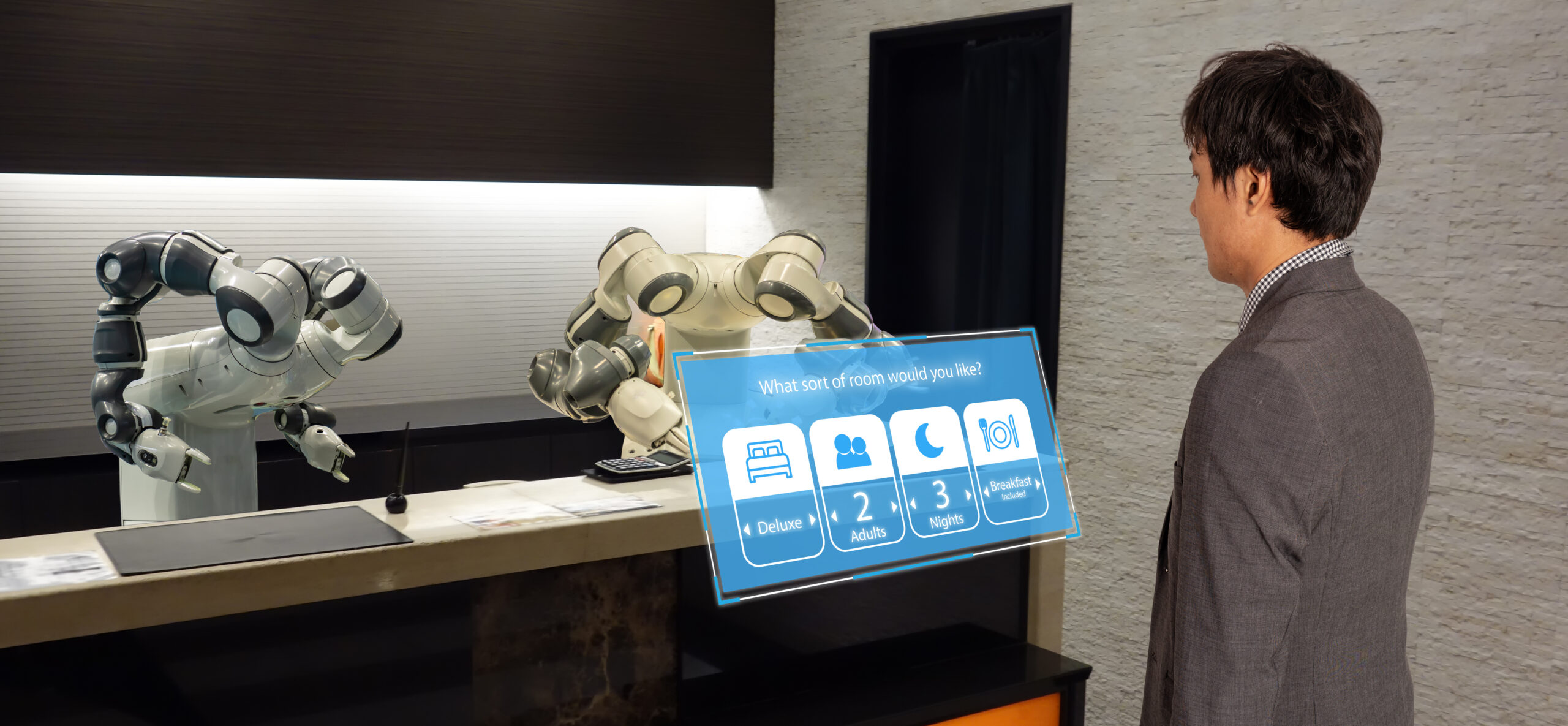
RPA rescue the hospitality industry ride the roller coaster of bookings; cancellations and amendments driven by the uncertainty of the current pandemic. The industry has seen that its time to change and that change will be permanent. The unprecedented impact from the COVID-19 Pandemic has thrown the hospitality industry into uncharted waters. There are so many unknowns and concerns for the immediate future. Hospitality businesses are expected to make considerable changes to their operations to safeguard employees’ and customers and re-engage with them to build their willingness to patronize their business. An unexpected by-product is that many businesses have taken the opportunity of site closures, restrictions to take a step back and take a long hard look at some fundamentals about their operations: What will the industry look like even in a post pandemic world? How can we prepare for the potential rollercoaster of impending rapidly imposed/relaxed lockdowns and restrictions? How do we interact and yet still delight our customers in the future? Digital is now a prevailing concept. The hospitality sector is looking to capitalize on such technologies to support customers choices as to whether they want to interact or distance themselves and how and how/when they to book. Industry leaders must look at tech-enabled solutions to increase operational efficiency and manage increasing volatility in operational processing of data. Suddenly when there is a lockdown, everyone cancel’s/amends their booking then lockdown eases everybody remakes their bookings. Some organizations now have 10s of thousands of emails sitting in inboxes waiting to be processed and are finding it difficult to ride the roller coaster. This is where RPA rescue the hospitality Industry is now turning increasing to a digital workforce. Robotic Process Automation (RPA) can automate time consuming processes and effectively drive greater efficiency. A robot can easily pick up the slack and process. Digital workers can work 24/7 and additional robots brought on-stream to cater for volatile demands. They fit right into the digital world. A key feature of RPA is that solutions can be delivered quickly and very cost effectively. This technology provides the adaptability and flexibility to integrate disparate systems and processes without the need of expensive source system developments and enhancements. Evolving a digital workforce can free up experienced staff to tackle evolving Covid-19 challenges.
Automotive Sector – Boost Sales using Digital Employees

Automotive Challenge Businesses across the board have been affected one way or another by Covid-19. We work with organizations in the automotive sector who saw a complete halt on operations a few months ago. They now have the rapid need to generate as much revenue going forward as economies try and open, with the possibility they may lock down again. Major fundamental changes within the industry are anticipated that will affect everything from production, electric vehicle demand and supply chains. Suppliers’ margins were already being pinched during the downturn in global economic activity before Covid-19, the ongoing uncertainty and volatility will only make things worse. Showrooms & Dealerships at the front line Covid-19 has exposed the lack of digitization across automotive sales and marketing with the absence of access to dealers in the new digital environment, where customers are immersed in e-commerce across all aspects of their lives. The existing Single-channel operational strategies are old hat and not the way that people now want to consume products and services. Flexible approaches to multichannel selling and the total support for automotive sales will be crucial to future success Agility and flexibility will be key, especially when considering a possible second or third wave of the pandemic. The limitations of availability and the way that staff can work in dealerships needs also to be thrown into the mix. Going forward having information at the fingertips of the people dealing with customers is going to be imperative. Being able to turn around deals, transactions and having highly efficient, effective and adaptive back office operations will become a key differentiator. RPA – Robotic Process Automation can be highly effective in this space, using RPA Digital Workers to drive down transaction times by streamlining the marshalling of information from many disparate sources to support vehicle sales process cycle. It releases people from undertaking transactional wasteful back office functions, accessing multiple systems to release them to be customer facing, supporting/integrating multi channel sales efforts. The outcomes from a Digital Worker can be put directly into the hands of dealership staff or used to support customers directly through an online platform, where speed of information is of the essence. The best part is that these robots interact with computing applications just like humans and as a result are non-intrusive, but can be deployed within a matter of days. Using a flexible resource like a Digital Worker to match constantly changing circumstances without having to resort to massive investments in source system reconfigurations can make all the difference and keep you agile.
Navigating Complex Supply Chain Systems to Drive Business Transformation

It seems each year the invent of new technology gives us an opportunity to transform our processes but too often the Supply Chain industry finds itself weighed down by multiple systems and Integrating legacy applications. In a digital first world, continued acceleration in adopting innovative technology is vital to success. Sudden impact of Covid-19 only highlighted the gaps in digitization of the modern supply chain and companies with weak or ill-defined digital projects are being left behind at a pace never seen before. However, it is not easy to simply replace legacy systems or share data among the various functional tools to get an edge. So how does one go about digital transformation to solve short-term business objectives while ensuring long-term viability? Digital Workers (RPA – Robotic Process Automation) are enabling the industry to overcome such barriers by simply providing a digital assistant to your teams to overcome shortcomings in integrations, removing the laborious task of data redundancy, improving accuracy of information across platforms, and providing fast and more accurate information to customers and management for rapid decision making. CEO’s are realizing that Digital Workers enable their teams to execute short and long-term strategies without significantly increasing headcount or adding additional projects on their already strained IT teams. Here is where Digital Workers add value to supply chain by picking up repetitive tasks and bridging the gap between multiple applications: Shipment scheduling, tracking, and communications Invoice processing Load management Order processing (don’t have an EDI option with a partner, no sweat – use a Digital Worker!) Supply and demand planning Communications and Alerting Inventory tracking, vendor managed inventory, consigned inventory Bridge data gaps between any of your existing applications Reduce data redundancy errors and mistakes Remove silos and improve cross-functional collaboration Virtual servicing Enable digital commerce How We Enable Digital Transformation with Digital Workers Keep your legacy systems and embrace a digital first mindset, while improving operational efficiencies at reduced costs and with rapid deployment. At Centelli, we deploy Digital Workers. Digital Workers are like a virtual assistant for your teams that work 24×7 without breaks, without holidays, without calling in sick and without making any errors. Deploy Digital Workers now to move business forward! It is expected that 72% of companies will use Digital Workers in the next 2 years alone. Integrating Legacy applications are no longer a barrier to transform – in fact keep them! Contact Centelli
BREXIT: RPA to the Rescue?

The one thing certain about the uncertainty of Brexit… …is that things will change. Businesses are being urged to consider all possibilities. But, many are unable to see the way forward. Only a fifth of small/med British businesses exposed to Brexit has prepared for the UK leaving without a deal…what to do? How about decluttering your business and building some internal capacity that can absorb the forthcoming changes, up to and after the end of October, even throughout any delay…and be able to react to whatever/whenever a turbulent post-Brexit deal/no-deal world looks like? Robotic Process Automation (RPA) empowered Digital Workers help to take away repetitive tasks that clog up your systems and processes. This gives you the space to use the expertise of your people to deal with whatever Brexit will throw at them. Think about it, for once you could be ahead of the game, and even if there’s no Brexit you have the dividend of such capacity to reinvest into your real business! A win-win. One thing is inevitable with Brexit, new regulations/processes and a whole new-fangled bureaucracy to deal with. Existing systems and process could struggle to cope; where processes, systems and interfaces could take a long time to modify. Inevitably there will be manual workarounds galore to bridge the gaps. Yet another set of Excel spreadsheets! With RPA, not only will you be getting productivity improvements here and now. But you are gaining valuable knowledge and experience of how your digital workers can rapidly react in the future. Experience shows us that RPA can be swiftly deployed in days/weeks, rather than months, to streamline and automate areas where systems interact. A digital worker can work across multiple systems seamlessly, without the need for cumbersome interfaces, which is invaluable if you have to move fast post Brexit. “To Brexit or Not to Brexit…That is the question… “. So maybe it’s time to acquaint yourself with RPA technology and understand what it can do…RPA and the associated deployment of digital workers may be the answer to free up capacity in your business… …but also remember, “digital workers are for life – and not just for Brexit!” localhost/centelli/
What Can Be Learned From The First Wave of RPA?

For many businesses, the initial implementation of RPA projects hasn’t been smooth sailing. In the technology’s early adoption, failures have been common. RPA uses software robots to take over repetitive and time-consuming tasks in organisations. This innovative and disruptive technology offers a multitude of benefits to organisations. These include cost-savings, to improved accuracy and increased customer satisfaction. However, with so much promise, why are there a multitude of RPA projects failing and what can be learned from these mistakes? In the recent 2019 Robotics and Automation Report by Raconteur in The Times supported by Centelli, the topic of learnings from the first wave of RPA is explored, particularly from the perspective of the industrial sector. The report highlights some of the reasons for RPA project failures and outlines some learnings for businesses moving forward: Most RPA failures are a result of human error rather than the technology itself In many of the early RPA projects, businesses note that the reason for failure has been down to human error. Either through a misunderstanding of the technology, inaccurate documentation of their own processes, poor implementation of the project, lack of expert support, insufficient maintenance after implementation or a host of other human errors. For RPA projects to be successful they cannot be viewed only as technology implementation projects delivered by IT. They are business projects with technology fuelling the desired outcome. The human element of these projects must be considered. Furthermore, businesses need to ensure they have the right support. From the very beginning of the project, right through to the ongoing collaboration with the digital workforce. A deep understanding of the processes that RPA will be taking over is key. In addition, so is ongoing maintenance of the digital workers. Read more about the learnings from the first wave of automation in the 2019 Robotics and Automation Report, supported by Centelli.
Frequently Asked Questions: Robotic Process Automation (RPA)

If you’re considering Robotic Process Automation (RPA), also known as a digital workforce, for your organisation, you might have a few questions that need answering before you go ahead with the investment. Here are some of our most frequently asked questions about our RPA solutions. If you’re still unsure or have questions, please get in touch to speak to one of our experts. Q: What can a digital worker do? A: A digital worker (also known as a bot) can do most of the routine tasks that are carried out by human workers. They access applications by taking over the keyboard and mouse of a computer, similar to the way a human would interact with them. Of course, a digital worker’s cognitive capabilities are lower than a human worker’s and they are therefore better suited to routine, repetitive and rule-based processes. Q: What are the various cost components to consider when deploying a digital worker? A: There are three components to consider when deploying a digital worker: UiPath, the software platform’s license costs; Infrastructure to run the software: this cost is similar to the cost of giving a human worker a laptop; Training cost (in other words how much it costs to configure the software): this depends on complexity but is comparable to training a human worker on the very same business process. In our experience, costs for deploying a digital worker can be recovered within a few months, while benefits like improved customer service and higher accuracy are available immediately. Q: Do RPA projects typically take long to implement? A: With UiPath, RPA projects can be deployed in as little as a few days and up to a few weeks. The best approach is to begin by enabling smaller processes or tasks and then growing from there. Q: How do we monitor and manage digital workers? A: Management of digital workers is best done through the digital team lead, called the UiPath Orchestrator. Orchestrator has a user-friendly interface which is used to monitor and manage the digital workforce. It has the functionality to schedule tasks, manage configuration, maintain queues, allocate tasks to the digital workers, and so on… basically, everything you would expect a human manager to do. Q: Are my processes suitable for RPA? A: Most routine, repetitive processes are suitable for RPA. Evaluate if a process is suitable or not by considering the following: Can the process, especially the exceptions, be documented? How many times a day, week or month does the process run? What effort is needed each time the process runs? What are the benefits of automation: for example, improved accuracy, reliability, response times, better scalability, productivity? Q: Is much ongoing support needed for my digital workforce? A: In most cases, ongoing support is negligible. Digital workers are trained to provide feedback on their work via email or logs. On occasions when an application is unreliable: for example when response times vary or there are inconsistencies in the business processes, human intervention might be needed. In these cases, intervention can be managed by a support team or an individual’s input can be planned into the digital workers’ processes. Q: What is the difference between AI and RPA? A: AI and RPA are complementary. AI is a broader field that deals with how computers interpret and analyse data. It is more analogous to how the human brain thinks. RPA, on the other hand, is automating processes as a sequence of tasks or defined steps similar to spreadsheet macros. For some tasks, such as extracting data from an invoice or scanned document, a digital worker needs capabilities similar to that of a human. At this point, AI would step in to provide the cognitive capabilities needed and would need to be trained over a number of iterations. On the flip side, an AI algorithm needs to fit into a business process to be of value. RPA can provide the surrounding infrastructure such as sourcing data and taking action on the output of the AI algorithm. Q: What training do my staff need to collaborate with digital workers? A: The simple answer is No; staff collaborate with digital workers in the same way they collaborate with a human team or team member. Digital workers provide their process updates for example through email or an updated file and receive instructions through the digital team lead a user-friendly web application called UiPath Orchestrator. Q: How will digital workers complement my human workers? A: Digital workers will enhance human workers lives by automating routine and repetitive tasks freeing them to focus on more cognitive tasks and in providing greater direct customer experience. Eventually, when all computing applications seamlessly talk to each other, all routine tasks will be automated. In the meantime, there are gaps between applications which need to be filled by humans. Digital workers are typically taking over tasks that humans don’t want to or shouldn’t be doing. Q: Does the deployment of digital workers require changes to computing applications? A: No, it doesn’t. One of the biggest benefits of digital workers is that they are non-intrusive and don’t need any application changes. They are very good at linking standalone systems without the need for expensive interfaces. Digital workers interact with applications just like a human would – by providing keyboard and mouse input and reading the screen. This makes digital workers as versatile as humans and quick to deploy. Q: Are digital workers scalable? A: Scaling a digital workforce, either for a single robot or hundreds, takes only a few hours to do. Buy a license, allocate infrastructure, create application access and add to UiPath Orchestrator to enable it to start allocating tasks. Some of the activities such as infrastructure and application access are similar to recruiting a human worker. Beyond that, it is much faster! Still have questions? Please don’t hesitate to get in touch to speak to one of our experts.
The Rise of RPA & Its Impact on The Workforce

Will RPA have an impact on your workforce and reshape the labour market in years to come? Robotic Process Automation (RPA) is growing rapidly. As more and more organisations are adopting this crucial tool along their digital transformation journey, seeking the unprecedented benefits of elevated productivity and value that automation provides. It is becoming increasingly important for leaders to understand the impact this will have on their workforce and the labour market. RPA is growing rapidly While the RPA industry is still in its early stages, this innovative technology is being widely implemented across a number of businesses in various industries. The 2019 Robotics and Automation Report recently published by Raconteur in The Times (supported by Centelli) notes that RPA has grown by 63% in 2018 and is expected to grow a further 54% in 2019 – making it the fastest-growing enterprise-software category. Download: Robotics and Automation Report Benefits of RPA on the workforce With the rapid adoption of this transformative technology, organisations and leaders need to consider how this will impact their workforces and the labour market. Therefore, the implementation of RPA can bring invaluable benefits to an organisation from a workforce perspective, including: Increased productivity as repetitive processes are handed over to digital workers More time for employees to perform value-adding tasks that improve quality and service Heightened employee engagement as teams are released from mundane activity How RPA is changing the labor market However, with these benefits comes an element of change that you can manage effectively. The rise of automation and RPA is expected to change the current split in type of work carried out by the workforce. Experts agree that the change will bring about a major increase in the need for social/emotional and technological skills. Trending skills for a human-robot collaborative workforce In a survey of business leaders, results show that the key skills that will be in demand in 2022 for a workforce that embraces human-robot collaboration will be: Analytical thinking and innovation Active learning and learning strategies Creativity, originality and initiative Technology design and programming Critical thinking and analysis Complex problem solving Leadership and social influence Emotional intelligence Reasoning, problem-solving and ideation Systems analysis and evaluation Embracing the future of a digital workforce Rather than fearing the inevitable change that will continue to come from the rise of RPA, we encourage organisations to view transformation and automation as a major opportunity that will benefit both organisations and employees alike. Robotics and automation are not here to take away human roles or make your current staff redundant. Instead, RPA is an effective solution for creating additional capacity within your teams to carry out more value-adding tasks. These will benefit your business quality of work and customer service. In addition, it will also create more engaging and fulfilling roles for your employees. Centelli RPA RPA is about more than just technology; it is about empowering workforces and organisations. At Centelli, we too are about more than just technology. With strong expertise in process optimisation and business operations, our team offer a service that goes far beyond simply providing a technological solution. We help organisations foster an environment suitable for effective human-robot collaboration and help businesses to make the most of a digital workforce. Get in touch to speak to one of our experts.
Robotics and Automation Report 2019
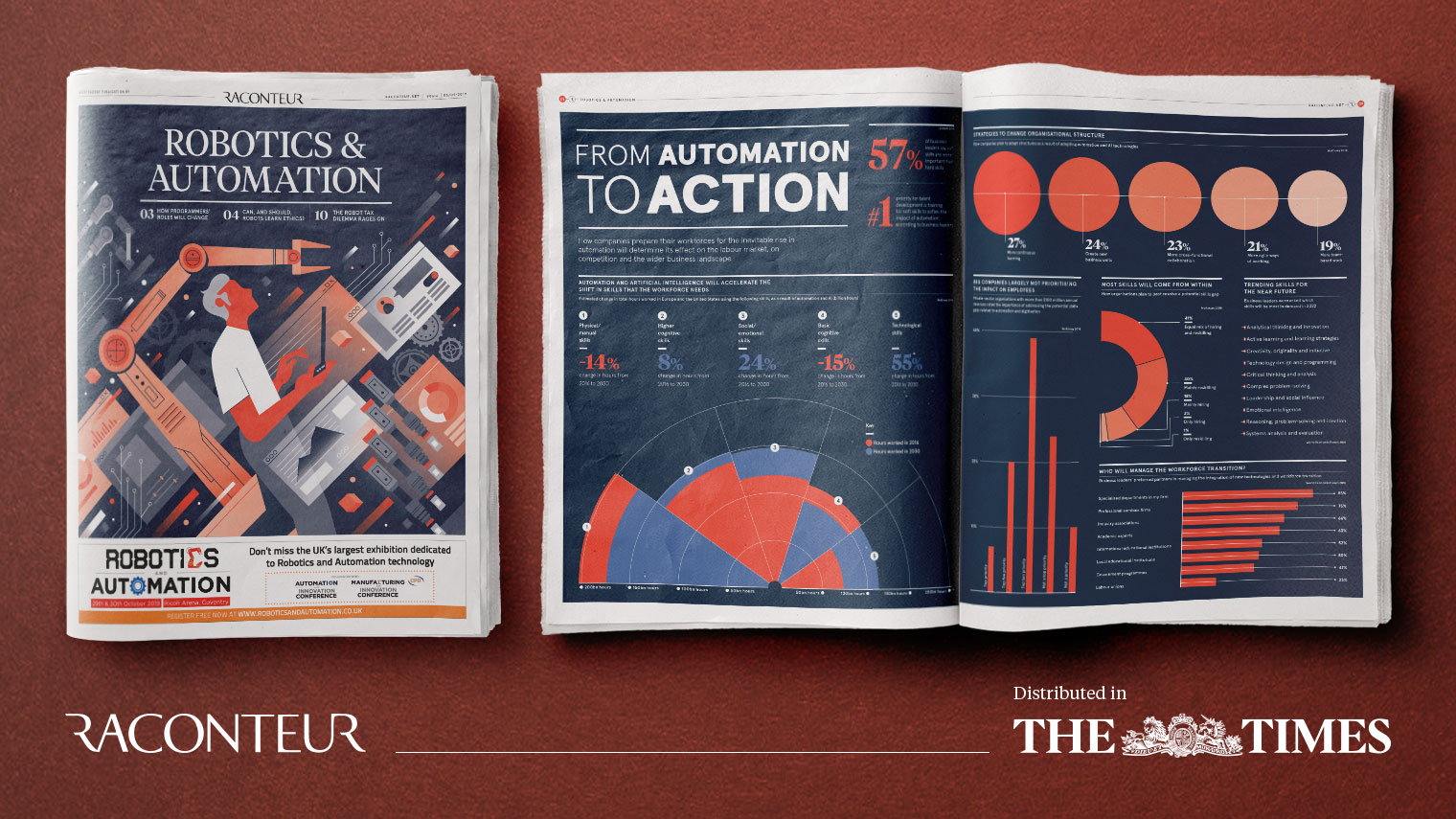
Centelli have been proud to support the latest Raconteur report in The Times which delves into the world of Robotics and Automation and how it is changing the way we work. In 2019’s digital era, automation is something that businesses and leaders cannot ignore. This report looks at what changes need to be made in our current systems to adapt to a new world where robots are increasingly being integrated into society. Download the report to read about how companies can prepare their workforces for the inevitable rise in Robotics and automation, how to improve organisations efficiency using robotic process automation and what mistakes to avoid when pursuing human-robot collaboration within your workforce. Download the full report here.